Agentic Engineering: The Skills That Matter Beyond Coding
AI-assisted, human-edited
This article was drafted with the help of large language models and reviewed by a Shine Soft Corp engineer before publication. Facts, citations, and code samples were verified against the linked sources. All opinions and editorial direction belong to the editor.
As AI continues to automate implementation, the engineers who thrive will not be the fastest coders. They will be the people who ask better questions, make better decisions, and de
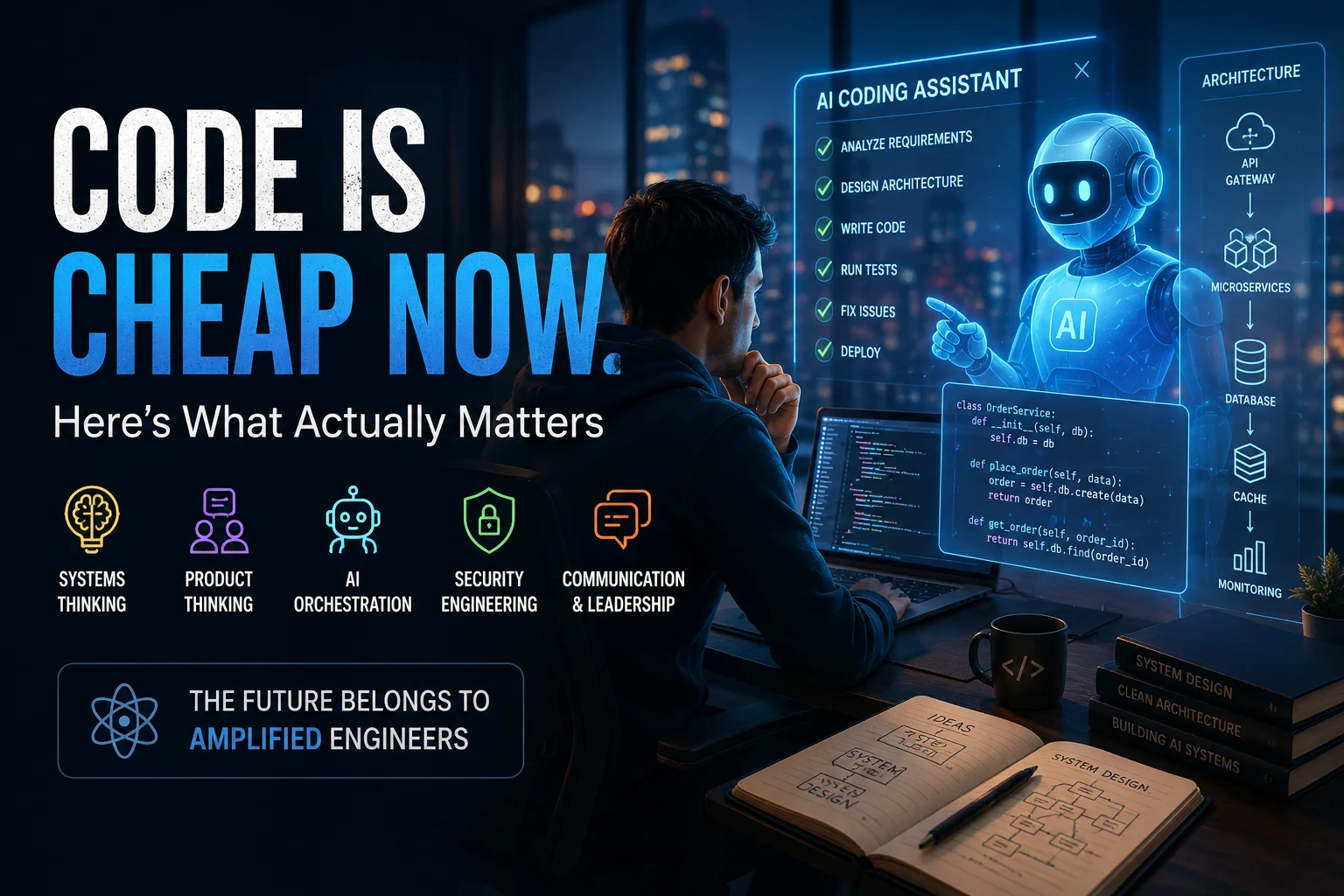
Code Is Cheap Now. Here's What Actually Matters in the AI Era
The Great Shift Nobody Is Talking About
For decades, software engineering was largely measured by one thing:
How fast and how well you could write code.
That assumption is breaking.
The emergence of advanced coding agents, autonomous software assistants, and increasingly capable AI models has pushed us into a new era. Models can now generate thousands of lines of production-grade code, write tests, fix bugs, refactor architectures, and even complete entire features with minimal supervision.
The barrier to creating software has never been lower.
And that changes everything.
The question isn't:
"Will AI replace programmers?"
The real question is:
"What skills remain valuable when everyone has access to an army of AI developers?"
The answer may determine who thrives in the next decade of software engineering.
Code Has Become a Commodity
Historically, writing code was expensive.
Companies hired engineers because translating business ideas into software required specialized knowledge.
Today, AI can generate:
- CRUD applications
- API integrations
- Database schemas
- Authentication systems
- Mobile app screens
- Unit tests
- Infrastructure templates
- Deployment pipelines
In many cases, faster than humans.
The bottleneck is no longer writing code.
The bottleneck is knowing:
- What to build
- Why it matters
- How it should behave
- How it integrates into a larger ecosystem
Coding is becoming a commodity.
Thinking is becoming the premium skill.
The Rise of Agentic Engineering
We're moving from software development to agentic engineering.
Instead of manually writing every function, engineers increasingly orchestrate systems of AI agents that:
- Analyze requirements
- Generate implementation plans
- Write code
- Execute tests
- Fix failures
- Deploy updates
- Monitor outcomes
The engineer becomes less of a typist and more of a systems architect.
Future developers won't compete on typing speed.
They'll compete on:
- Decision quality
- Architectural thinking
- Product understanding
- Risk assessment
- Human judgment
What AI Still Can't Do Reliably
AI is astonishingly capable.
But capability isn't the same as responsibility.
AI can generate solutions.
Humans must determine whether those solutions should exist.
AI still struggles with:
Context
Businesses operate in messy environments.
Requirements conflict.
Stakeholders disagree.
Regulations change.
Priorities shift.
Humans navigate ambiguity.
Trade-Off Decisions
Every architecture has trade-offs.
Performance vs cost.
Speed vs reliability.
Flexibility vs complexity.
AI can suggest options.
Experienced engineers choose among them.
Long-Term Ownership
Anyone can generate software.
Few can maintain it for ten years.
Scalable engineering is not about writing code.
It's about managing complexity.
The New Engineering Skill Stack
The most valuable engineers in the next decade won't necessarily be the strongest coders.
They'll be the strongest thinkers.
1. Systems Thinking
Understanding how components interact across:
- Applications
- APIs
- Databases
- Networks
- Security boundaries
- Business workflows
AI can build pieces.
Humans design ecosystems.
2. Product Thinking
The best engineers understand:
- Users
- Markets
- Revenue models
- Customer pain points
Building the wrong thing faster creates bigger failures.
3. AI Orchestration
Modern engineers must learn:
- Prompt engineering
- Agent workflows
- Multi-agent systems
- Context management
- Tool integration
- Retrieval-Augmented Generation (RAG)
- Evaluation frameworks
This is becoming as fundamental as learning Git.
4. Security Engineering
AI-generated code introduces new risks.
Developers who understand:
- Authentication
- Authorization
- Secure design
- Threat modeling
- Compliance requirements
will become increasingly valuable.
5. Communication
The highest-paid engineers increasingly act as translators between:
- Business leaders
- Customers
- Designers
- AI systems
- Engineering teams
Communication becomes leverage.
Skills Every Developer Should Learn Today
If you're starting or growing your career in 2026 and beyond, prioritize:
Must Learn
✅ AI-Assisted Development
✅ System Design
✅ Cloud Architecture
✅ Cybersecurity Fundamentals
✅ API Design
✅ Data Engineering
✅ Product Management Concepts
✅ Technical Communication
✅ AI Agent Frameworks
✅ Automation Engineering
Nice To Have
- Competitive Programming
- Framework-Specific Expertise
- Advanced Frontend Animations
- Niche Language Mastery
These still matter, but they no longer create the same career advantage.
The New Career Pyramid
Level 1 — Code Producers
Generate software.
Increasingly automated.
Level 2 — Problem Solvers
Use AI to deliver business outcomes.
Highly valuable.
Level 3 — System Architects
Design scalable systems.
Extremely valuable.
Level 4 — Product Builders
Understand customers, markets, and technology.
Rare.
Level 5 — Visionaries
Identify opportunities before others see them.
Virtually irreplaceable.
What Companies Will Pay For
The highest compensation won't go to people who can write functions.
It will go to people who can:
- Reduce business risk
- Increase revenue
- Improve customer experience
- Design scalable systems
- Lead AI-powered teams
- Make high-quality decisions
Software becomes abundant.
Judgment becomes scarce.
Scarcity creates value.
The Future Belongs to Amplified Engineers
The winners won't be engineers who fight AI.
The winners will be engineers who amplify themselves with AI.
The future developer looks less like a coder and more like:
- A strategist
- A systems designer
- A product thinker
- An AI orchestrator
- A decision maker
The keyboard isn't disappearing.
It's simply becoming less important than the mind behind it.
Final Thoughts
Code is becoming cheaper every month.
But understanding humans, businesses, systems, and consequences remains extraordinarily valuable.
As AI continues to automate implementation, the engineers who thrive will not be the fastest coders.
They will be the people who ask better questions, make better decisions, and design better futures.
In the AI era, code may be cheap.
But wisdom has never been more expensive.