Japan Just Changed AI Forever: How Sakana's Fugu Challenges Anthropic Without Building a Bigger Model
AI-assisted, human-edited
This article was drafted with the help of large language models and reviewed by a Shine Soft Corp engineer before publication. Facts, citations, and code samples were verified against the linked sources. All opinions and editorial direction belong to the editor.
Japan's Sakana AI launched Fugu, an AI orchestrator that coordinates multiple frontier models instead of training one giant LLM. Here's why this could reshape the future of artificial intelligence.
Japan Just Changed AI Forever: How Sakana's Fugu Challenges Anthropic Without Building a Bigger ModelJapan's Sakana AI launched Fugu, an AI orchestrator that coordinates multiple frontier models instead of training one giant LLM. Here's why this could reshape the future of artificial intelligence.
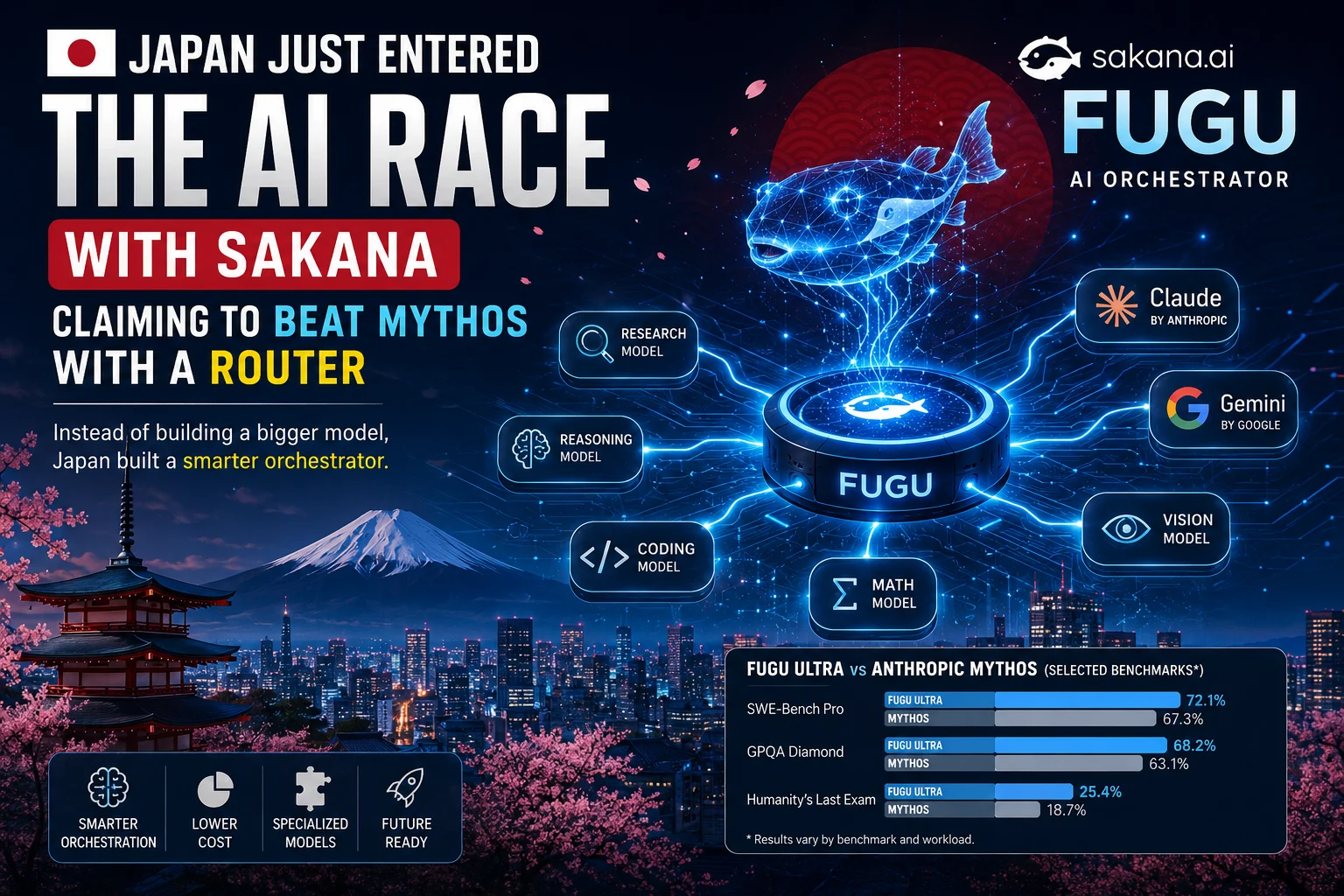
🇯🇵 Japan Just Entered the AI Race — And It Didn't Build a Bigger Model
What if the next AI breakthrough isn't a larger model... but a smarter orchestrator?
For the past three years, the AI race has looked predictable.
- OpenAI builds larger GPT models.
- Anthropic pushes Claude.
- Google scales Gemini.
- xAI trains Grok.
Everyone assumed the winner would simply own the largest GPU cluster.
Japan just challenged that assumption.
Instead of training another frontier LLM, Tokyo startup Sakana AI introduced Fugu, an AI orchestration system that claims performance approaching—or exceeding on selected benchmarks—Anthropic's restricted Mythos/Fable models by intelligently coordinating multiple existing frontier models rather than replacing them. These performance claims come from Sakana's published evaluations and should be interpreted as benchmark-specific rather than universal superiority. :contentReference[oaicite:0]{index=0}
This is a completely different way of thinking about AI.
Why This Matters
The timing wasn't accidental.
Shortly after U.S. export controls limited global access to Anthropic's most capable models, many organizations suddenly lost access to frontier AI capabilities.
Instead of competing with a giant foundation model...
Sakana asked a different question:
What if one intelligent router could coordinate multiple AI models better than any single model alone?
That idea became Fugu. :contentReference[oaicite:1]{index=1}
The Traditional AI Stack
flowchart LR

    User([👤 User])
    AI["🧠 Traditional AI"]

    User --> AI

    AI --> Reasoning["💭 Reasoning"]
    AI --> Coding["💻 Coding"]
    AI --> Writing["📝 Writing"]
    AI --> Research["🔍 Research"]
    AI --> Tools["🛠️ Tool Use"]

    Reasoning --> Answer([✅ Answer])
    Coding --> Answer
    Writing --> Answer
    Research --> Answer
    Tools --> Answer

    classDef user fill:#3b82f6,color:#fff
    classDef ai fill:#7c3aed,color:#fff
    classDef answer fill:#16a34a,color:#fff
    classDef task fill:#eef2ff,color:#111827

    class User user
    class AI ai
    class Answer answer
    class Reasoning,Coding,Writing,Research,Tools task
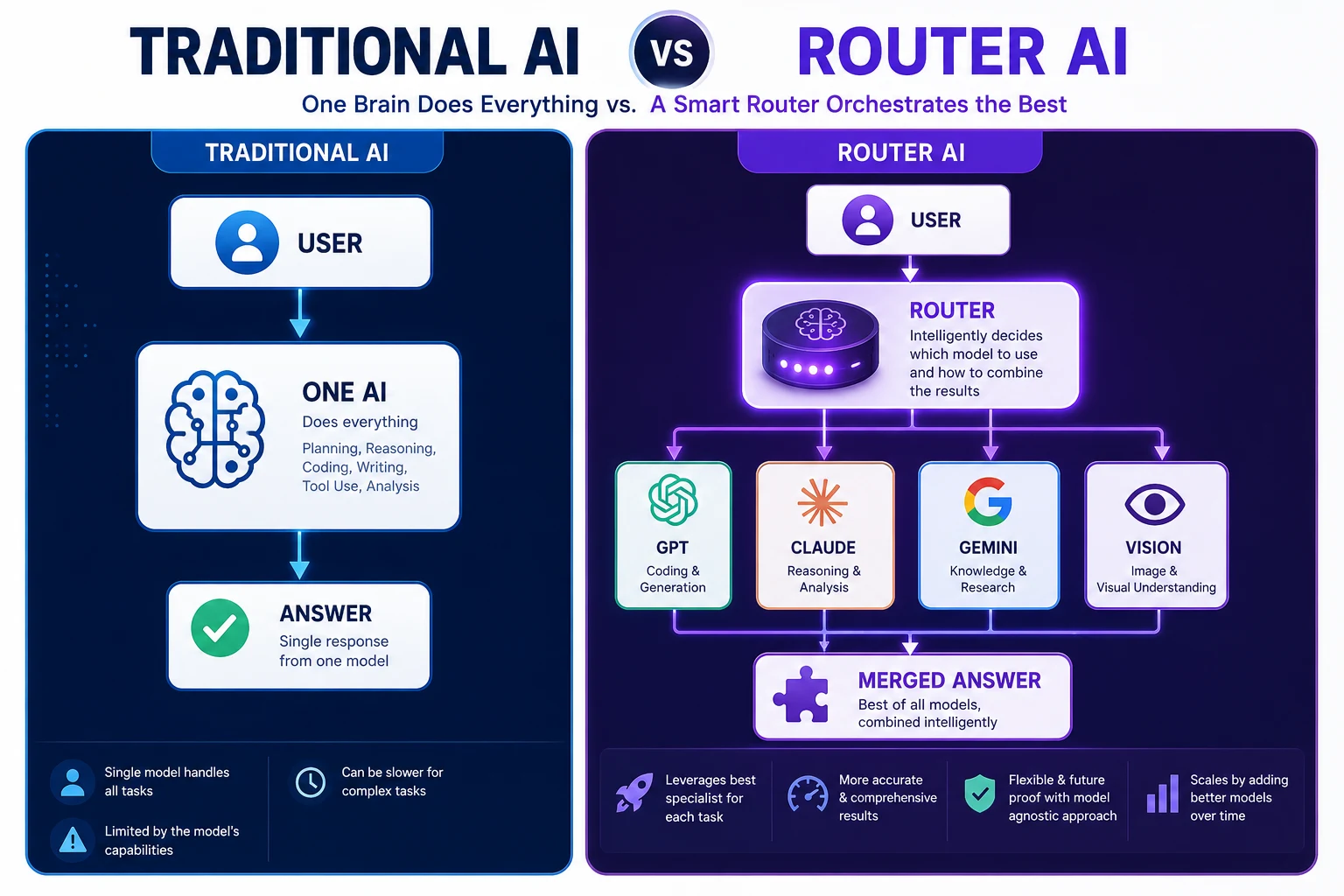
A single model performs everything:
- Planning
- Coding
- Reasoning
- Tool use
- Writing
- Validation
Simple.
But not always optimal.
Sakana's New Architecture
Instead of one massive brain...
Fugu acts like an orchestra conductor.
flowchart TD

U[User Request]

R[Fugu Orchestrator]

C1[Reasoning Model]
C2[Coding Model]
C3[Research Model]
C4[Vision Model]

M[Merge Results]

A[Final Answer]

U --> R

R --> C1
R --> C2
R --> C3
R --> C4

C1 --> M
C2 --> M
C3 --> M
C4 --> M

M --> A
The orchestrator decides:
- Which model should solve each sub-problem
- Whether tasks should run in parallel
- How outputs should be verified
- How to merge everything into one coherent response
Think of it as an AI project manager supervising specialist AI workers.
Why This Is Different
Traditional AI tries to make one model good at everything.
Fugu tries to make multiple models collaborate.
Instead of:
One giant expert
You get:
Team of specialists + Smart manager = Better outcome
This resembles how software engineering teams actually work.
Why "Router AI" Could Be the Next Big Trend
Large Language Models are increasingly becoming commodities.
Every few months:
- Better coding model
- Better reasoning model
- Better vision model
- Better math model
Eventually...
Choosing which model becomes as important as training a model.
That makes routing itself a competitive advantage.
Fugu Workflow
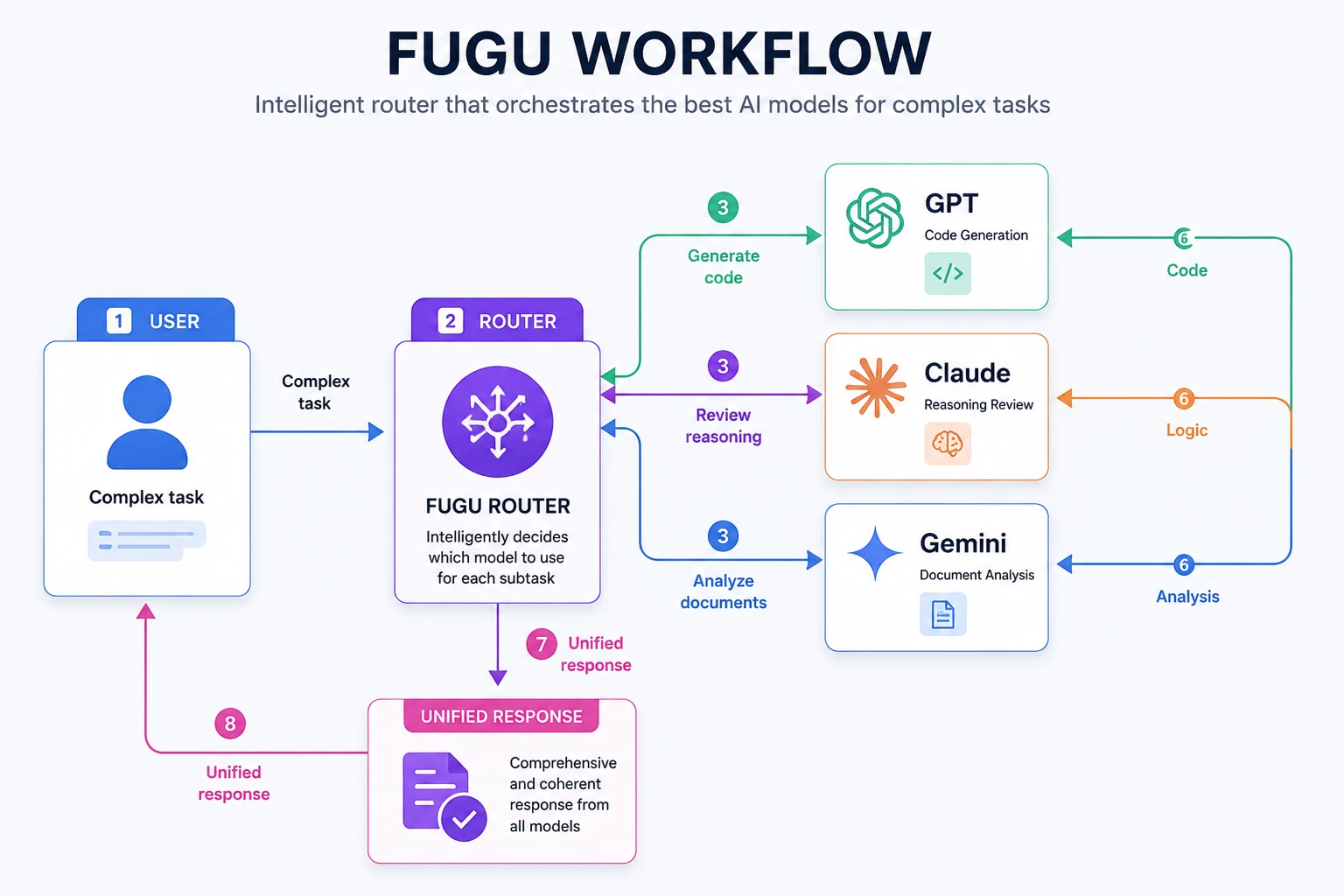
sequenceDiagram

participant User
participant Router
participant GPT
participant Claude
participant Gemini

User->>Router: Complex task

Router->>GPT: Generate code
Router->>Claude: Review reasoning
Router->>Gemini: Analyze documents

GPT-->>Router: Code
Claude-->>Router: Logic
Gemini-->>Router: Analysis

Router->>User: Unified response
Instead of asking one AI...
You're asking an AI that knows which AI to ask.
Reported Benchmark Results
According to Sakana's technical report, Fugu Ultra achieved strong results across several demanding evaluation suites including:
- SWE-Bench Pro
- TerminalBench
- LiveCodeBench
- GPQA Diamond
- Humanity's Last Exam
- CharXiv Reasoning
Sakana argues that adaptive orchestration can outperform individual publicly available models on several benchmark suites, though independent real-world validation is still ongoing and some reviewers have raised latency concerns. :contentReference[oaicite:2]{index=2}
Example
Imagine asking:
Build a SaaS CRM with authentication, payments, documentation and deployment.
Traditional AI:
One model does everything.
Fugu:
Router

├── Coding AI
├── Security AI
├── Database AI
├── Documentation AI
├── DevOps AI
└── QA AI
Each specialist solves part of the project.
The router combines everything.
Why This Matters for Developers
This architecture hints at where enterprise AI may be heading.
Instead of asking:
Which LLM should we buy?
Companies may ask:
Which orchestrator should manage all of our AI systems?
That changes the economics of AI dramatically.
Potential Advantages
✅ Lower training cost
✅ Better specialization
✅ Easier model upgrades
✅ Vendor flexibility
✅ More resilient architecture
✅ Can integrate future models without retraining an entire foundation model
Potential Challenges
❌ Higher latency due to multiple model calls
❌ Increased API costs
❌ Complex orchestration logic
❌ Benchmark leadership doesn't always translate into production performance
❌ Greater engineering complexity
The Bigger Picture
The AI race is evolving.
Version 1:
Who builds the largest model?
Version 2:
Who builds the smartest AI ecosystem?
Sakana is betting that coordination beats scale.
Whether that proves true will depend on real-world adoption, cost, latency, and reliability—not benchmark scores alone.
Final Thoughts
The most interesting part of Fugu isn't that it's another AI model.
It's that it may signal the beginning of an "AI Operating System" era, where orchestration becomes more valuable than raw parameter count.
If that vision succeeds, the future of AI won't belong to one giant model.
It will belong to systems that know how to combine many models into one intelligent experience.
And Japan may have just shown the industry a different path forward.
References
- Sakana Fugu Technical Report
- Sakana AI Benchmark Results
- Anthropic Export Control News
- Public reports covering the Fugu launch and benchmark claims