Cursor's Massive 1.5 Trillion Parameter AI Model Could Change Software Development Forever
AI-assisted, human-edited
This article was drafted with the help of large language models and reviewed by a Shine Soft Corp engineer before publication. Facts, citations, and code samples were verified against the linked sources. All opinions and editorial direction belong to the editor.
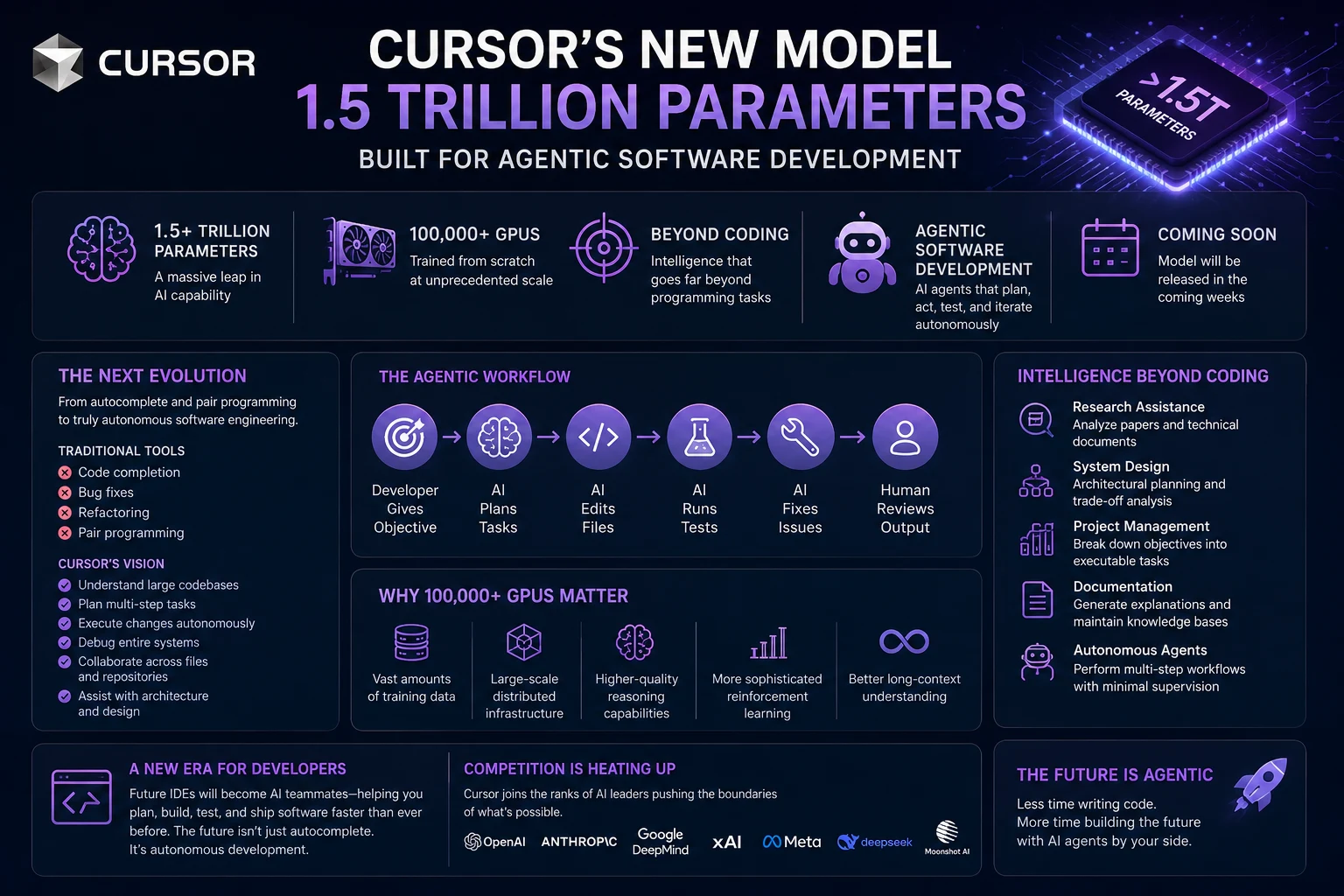
Cursor has revealed an enormous new AI model trained from scratch on over 100,000 GPUs. With more than 1.5 trillion parameters and intelligence beyond coding, it aims to push agentic software development far beyond autocomplete.
Cursor's Massive 1.5 Trillion Parameter AI Model Could Change Software Development ForeverCursor has revealed an enormous new AI model trained from scratch on over 100,000 GPUs. With more than 1.5 trillion parameters and intelligence beyond coding, it aims to push agentic software development far beyond autocomplete.
Cursor's Massive 1.5 Trillion Parameter AI Model Could Change Software Development Forever
The race for next-generation AI models just became even more interesting.
Cursor, the company behind one of the fastest-growing AI coding assistants, has revealed that it is preparing to launch a brand-new foundation model containing more than 1.5 trillion parameters. Even more impressive, the model was reportedly trained from scratch using over 100,000 GPUs, representing a huge leap beyond Cursor's previous approach.
If the claims hold true, this could mark Cursor's transformation from an AI-powered editor into a full-fledged frontier AI company.
The End of Simple Autocomplete?
For years, coding assistants have largely focused on:
- Code completion
- Bug fixes
- Refactoring
- Pair programming
But Cursor says its upcoming model is designed for something much bigger:
Agentic software development
Instead of merely suggesting lines of code, AI agents are expected to:
- Understand large codebases
- Plan multi-step tasks
- Execute changes autonomously
- Debug entire systems
- Collaborate across files and repositories
- Assist with architecture and design decisions
In other words, the goal is moving from autocomplete to autonomous software engineering.
A Truly Massive Model
According to early reports, Cursor's upcoming model features:
| Specification | Details |
|---|---|
| Parameters | 1.5+ Trillion |
| Training Infrastructure | Over 100,000 GPUs |
| Training Method | Built from scratch |
| Intelligence Scope | Beyond coding |
| Release Window | Coming weeks |
| Focus | Agentic Software Development |
The scale places it alongside some of the largest frontier models currently available.
Why This Is Different
Previous Cursor models relied heavily on adapting existing open-source foundations.
This new system reportedly represents:
- A completely new pretraining effort.
- 10–20× more compute than previous Composer models.
- General intelligence capabilities beyond programming.
- Long-horizon reasoning abilities.
- Better support for autonomous agents.
The company appears to be betting that future developers will work alongside AI agents rather than traditional coding copilots.
What Is Agentic Software Development?
Agentic development refers to AI systems capable of independently performing complex tasks.
Instead of:
Developer → Writes code manually
The workflow becomes:
flowchart TB
A["🎯 Developer Defines Goal"]
B["🧠 AI Plans Tasks"]
C["💻 AI Edits Files"]
D["🧪 AI Runs Tests"]
E["🔧 AI Fixes Issues"]
F["👨💻 Human Reviews Output"]
A --> B
B --> C
C --> D
D --> E
E --> F
This shift could fundamentally change how software gets built.
Why 100,000 GPUs Matter
Training frontier models requires enormous computational resources.
Using over 100,000 GPUs means:
- Vast amounts of training data.
- Large-scale distributed infrastructure.
- Higher-quality reasoning capabilities.
- More sophisticated reinforcement learning.
- Better long-context understanding.
Only a handful of organizations currently possess resources at this scale.
Beyond Coding
Perhaps the most intriguing claim is that the model delivers intelligence beyond programming tasks.
That could enable:
Research Assistance
Analyzing papers and technical documents.
System Design
Architectural planning and trade-off analysis.
Project Management
Breaking down objectives into executable tasks.
Documentation
Generating explanations and maintaining knowledge bases.
Autonomous Agents
Performing multi-step workflows with minimal supervision.
Competition Is Heating Up
Cursor now joins an increasingly crowded field of AI giants competing for the future of software development:
- OpenAI
- Anthropic
- Google DeepMind
- xAI
- Meta
- DeepSeek
- Moonshot AI
Rather than remaining an application layer on top of others' models, Cursor appears to be building its own foundation model strategy.
Why Developers Should Pay Attention
The implications are enormous.
Future IDEs may become:
- Software teammates instead of assistants.
- Autonomous coding agents.
- Architecture advisors.
- Test engineers.
- Documentation writers.
- Full-stack collaborators.
The traditional notion of "pair programming" could evolve into something much closer to managing a team of AI engineers.
Questions That Remain
Despite the excitement, many details are still unknown:
- Will the model be proprietary?
- How expensive will it be?
- Which benchmarks will it target?
- How much better is it than existing models?
- Will it support open weights?
- Can it truly outperform GPT and Claude-class systems?
Until benchmarks and public access arrive, many questions remain unanswered.
The Bigger Picture
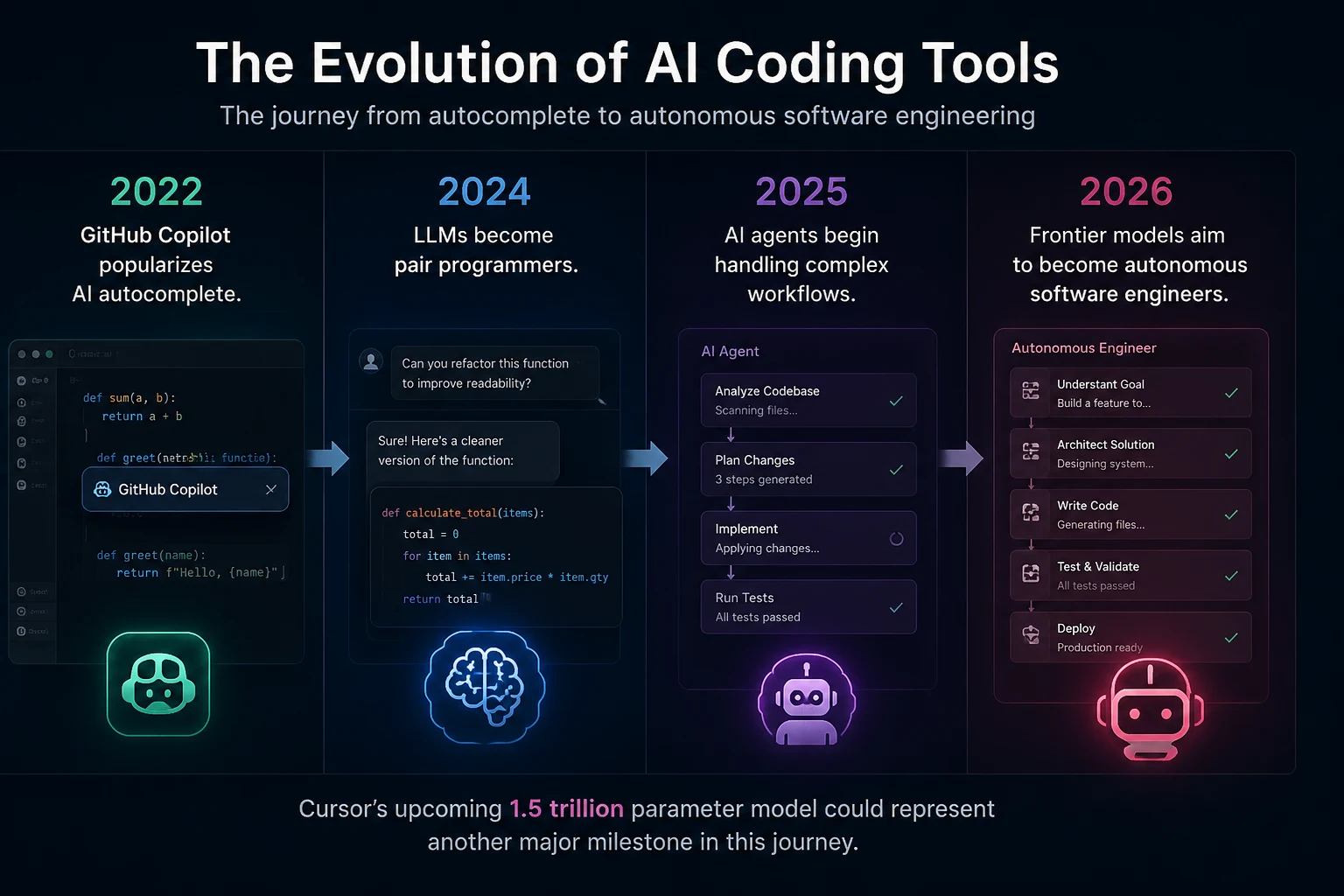
AI coding tools have evolved rapidly:
2022
GitHub Copilot popularizes AI autocomplete.
2024
LLMs become pair programmers.
2025
AI agents begin handling complex workflows.
2026
Frontier models aim to become autonomous software engineers.
Cursor's upcoming 1.5 trillion parameter model could represent another major milestone in that journey.
Whether it lives up to the hype remains to be seen, but one thing is becoming increasingly clear:
The future of software development may be driven less by writing code and more by directing intelligent agents.
Final Thoughts
Cursor's announcement signals a bold ambition: moving beyond coding assistants toward genuinely agentic AI systems.
If successful, developers may soon spend less time typing code and more time orchestrating AI teammates capable of understanding, planning, and building software at unprecedented scale.
The era of autocomplete may have been only the beginning.