Claude Fable 5 Model Review | CodeRabbit
AI-assisted, human-edited
This article was drafted with the help of large language models and reviewed by a Shine Soft Corp engineer before publication. Facts, citations, and code samples were verified against the linked sources. All opinions and editorial direction belong to the editor.
Source-driven breakdown: AI Engineering.
Info: AI summarisation failed — this draft was built directly from the source article. Edit and rewrite in your own voice before publishing.
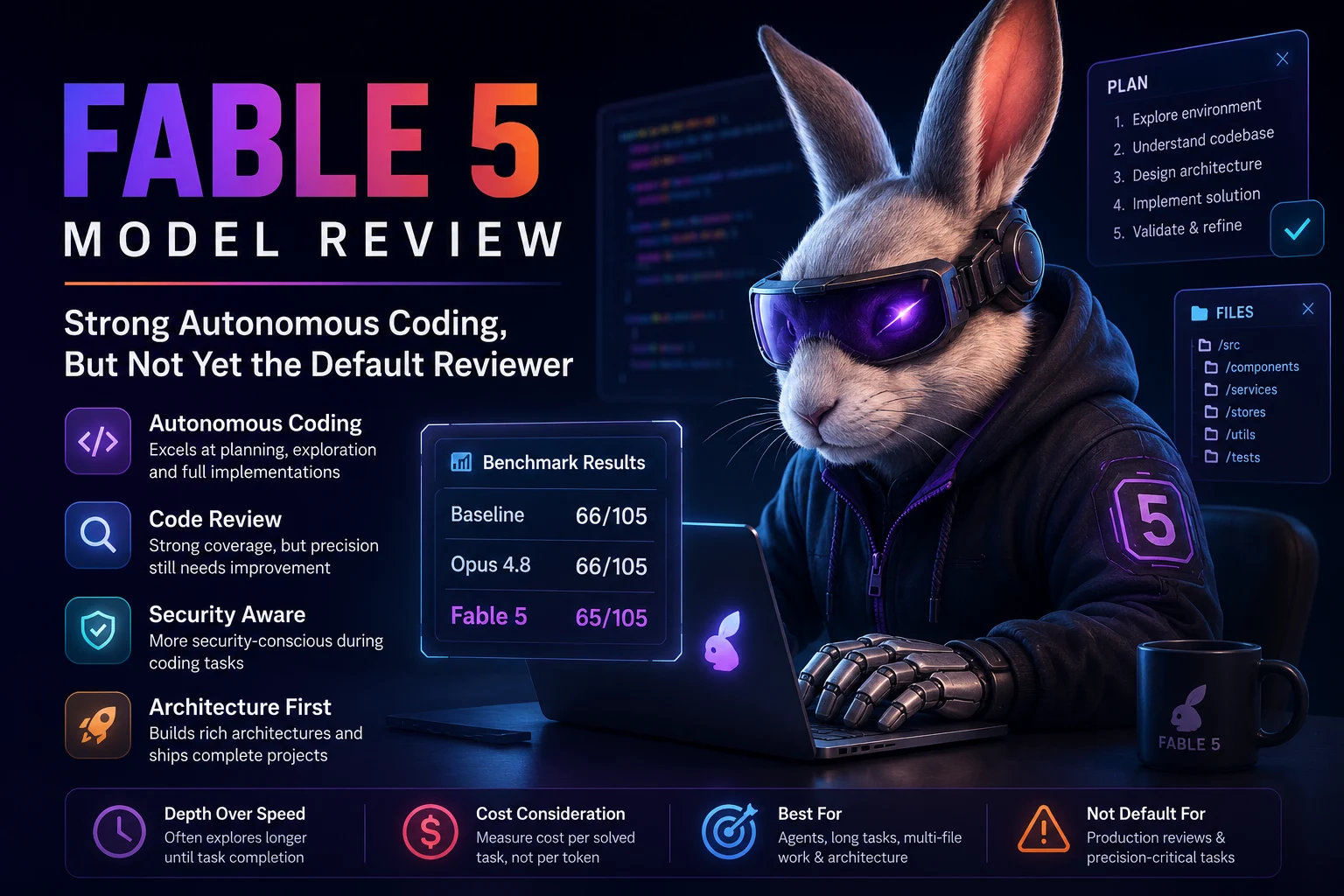
Fable 5 Model Review: Strong Autonomous Coding, But Not Yet the Default Reviewer
Fable 5
Fable 5 shines when tasks are vague and require exploration, planning, and implementation. However, for production code reviews, current baselines and Opus 4.8 remain safer choices.
Visual references
Image source: CodeRabbit
🚀 Quick Verdict
| Category | Rating |
|---|---|
| Autonomous Coding | ⭐⭐⭐⭐⭐ |
| Architecture & Planning | ⭐⭐⭐⭐⭐ |
| Code Review Precision | ⭐⭐⭐ |
| Speed | ⭐⭐⭐ |
| Cost Efficiency | ⭐⭐⭐ |
| Security Awareness | ⭐⭐⭐⭐ |
| Production Review Readiness | ⭐⭐⭐ |
What Makes Fable 5 Different?
Unlike traditional upgrades, Fable 5 is designed for:
- Long-running agent workflows
- Environment exploration
- Multi-file implementations
- Architecture-first development
- Reduced need for human guidance
Instead of repeatedly asking questions, it:
- Learns the environment.
- Understands available tools and constraints.
- Starts building immediately.
Code Review Performance
Coverage Is Strong
Fable 5 found nearly as many actionable issues as current baselines.
Benchmark Results
| Model | Actionable Passes |
|---|---|
| Baseline | 66/105 |
| Opus 4.8 | 66/105 |
| Fable 5 | 65/105 |
Precision Still Needs Improvement
While coverage is competitive, precision remains weaker.
Fable 5 tends to generate:
- More comments
- More nitpicks
- More assertive suggestions
This creates additional review overhead.
Hard Problems Still Favor Existing Models
On difficult EPs:
| Model | Score |
|---|---|
| Baseline | 10/16 |
| Opus 4.8 | 9/16 |
| Fable 5 | 8/16 |
For teams that prioritize trust and signal quality, existing reviewers still hold an advantage.
🔒 Security Perspective
Fable 5 appears more security-aware than generic coding models.
It performs best when:
✅ Security is part of a coding task.
Rather than:
❌ Acting as a dedicated security reviewer.
Recommendation: treat it as a coding assistant—not proof of security correctness.
Coding Benchmark Results
The model often continued exploring until benchmark timeouts occurred.
Outcomes
- 6 Passed
- 4 Failed
- 4 Cancelled
- 19 Timeouts
This reveals an interesting trade-off:
Fable 5 prefers depth over speed.
Why It Can Become Expensive
The cost isn't just token pricing.
Fable 5 spends resources on:
- Thinking longer
- Exploring solutions
- Architecture decisions
- Generating larger outputs
Therefore:
Measure cost per solved task, not per token.
Where Fable 5 Really Shines
The most impressive examples involved complete projects.
The model produced:
- State management layers
- Rendering systems
- Decision engines
- Controls and interactions
- Production builds
Instead of generating prototype shells, it delivered full applications.
🎥 Example Project
The original CodeRabbit article showcases one of the generated projects:
Architecture Is Its Biggest Strength
Compared to earlier models, Fable 5:
Earlier Models
- Over-explain plans
- Ask repeatedly for permission
- Require hand-holding
Fable 5
- Moves directly into implementation
- Builds richer architectures
- Handles interactions better
- Focuses on product shape
Recommended Use Cases
✅ Use Fable 5 For
- Autonomous coding agents
- Multi-file implementations
- Long-running workflows
- Exploration-heavy tasks
- Incomplete prompts
- Architecture design
⚠️ Avoid Making It Default For
- Production code reviews
- Precision-critical reviews
- Fast response workflows
- High-volume pull requests
Final Verdict
Fable 5 is not a "replace everything" model.
It excels when autonomy is the product.
For coding agents and deep implementation work, Fable 5 is extremely promising.
For code review, Opus 4.8 and current baselines still provide more trustworthy precision.
Key Takeaways
- ✅ Excellent at autonomous coding
- ✅ Strong architectural thinking
- ✅ Handles vague prompts surprisingly well
- ⚠️ Slower than many alternatives
- ⚠️ Can consume significant token budgets
- ⚠️ Precision in code reviews still needs improvement
The recommendation is selective adoption. Fable 5 is worth testing for autonomous coding work, especially tasks that benefit from deeper planning, multi-file execution, and extra time spent on implementation. I would not make it the default for production code review yet.
For code review, keep the current baseline or Opus 4.8 path as the default until Fable 5 improves on precision and comment volume. For coding agents, Fable 5 is more compelling, especially when the work benefits from exploration and deeper implementation. The guardrail is operational: give it clear budgets, stop conditions, and review checkpoints. For security workflows, position it as useful for security-sensitive implementation, not as proof of better security review.
Demo videos
References
This article was informed by reporting and engineering write-ups from the sources below. Please visit them for the original analysis:
Shine Soft Corp synthesizes and commentates on these sources; we do not republish their content.