Building Your Own Foundation Model (Part 3): Positional Encoding – How AI Understands Word Order
AI-assisted, human-edited
This article was drafted with the help of large language models and reviewed by a Shine Soft Corp engineer before publication. Facts, citations, and code samples were verified against the linked sources. All opinions and editorial direction belong to the editor.
Discover how positional encoding allows AI models to understand word order and context, going beyond just embeddings
Building Your Own Foundation Model (Part 3): Positional Encoding – How AI Understands Word OrderDiscover how positional encoding allows AI models to understand word order and context, going beyond just embeddings
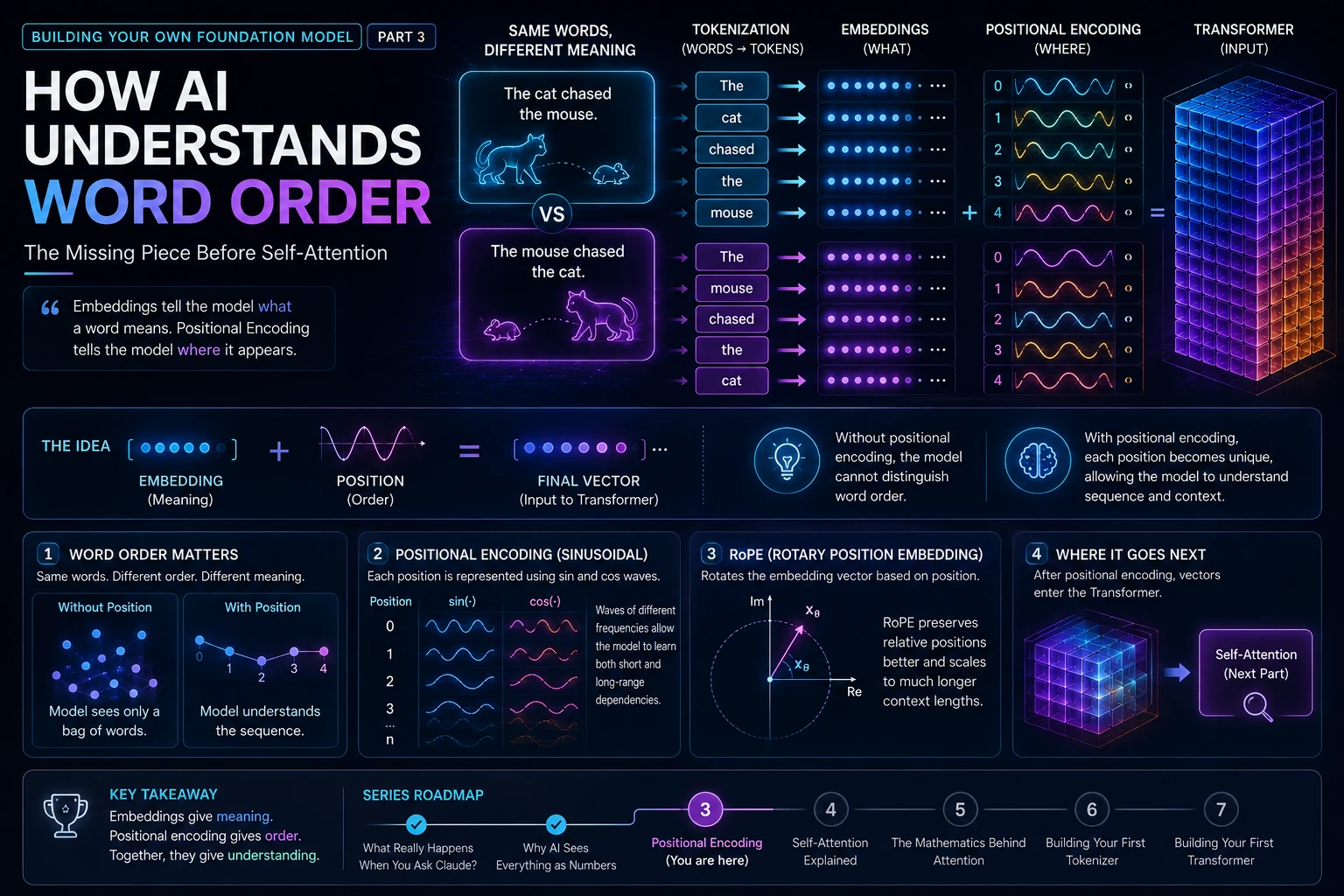
Building Your Own Foundation Model - Part 3
Part 3 — Positional Encoding
How AI Understands Word Order
"Embeddings tell the model what a word means.
Positional Encoding tells the model where it appears."
Did You Notice Something Strange?
Look carefully.
The cat chased the mouse.
and
The mouse chased the cat.
Exactly the same words.
Yet the meaning is completely different.
Now here's the surprising part:
Without positional encoding, a Transformer initially sees these as almost the same collection of word embeddings.
So how does Claude know which one is correct?
Let's find out.
Playground #1 — Word Order Challenge ⭐
Immediately create an "aha!" moment. Toggle With Positional Encoding off, then on.
Reader instantly understands WHY positions exist.
Continue Explanation
Now explain:
Embedding ≠ Position
Embeddings carry meaning.
Positions carry order.
The Transformer needs both.
Visual contrast (optional mini-widget)
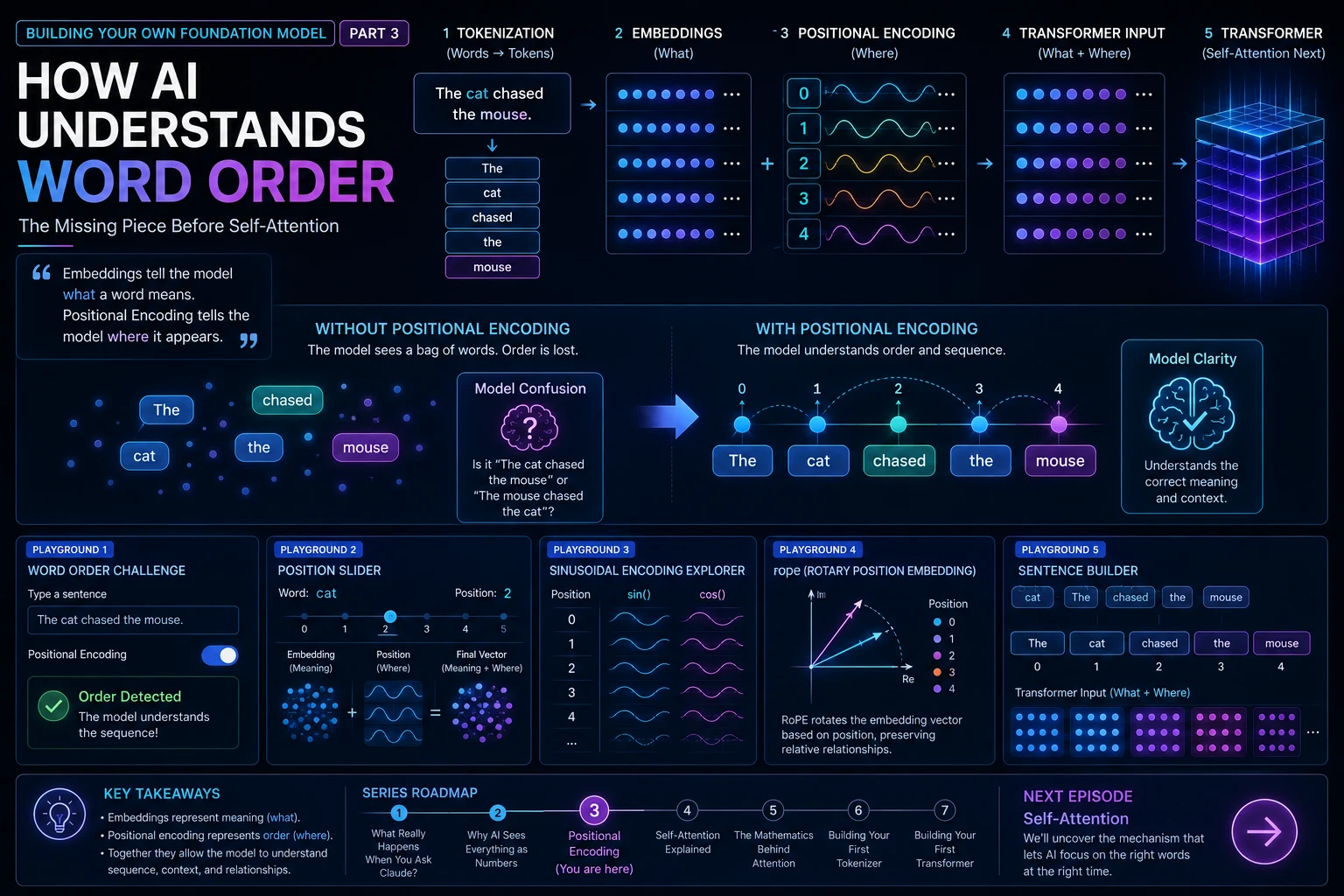
Explain
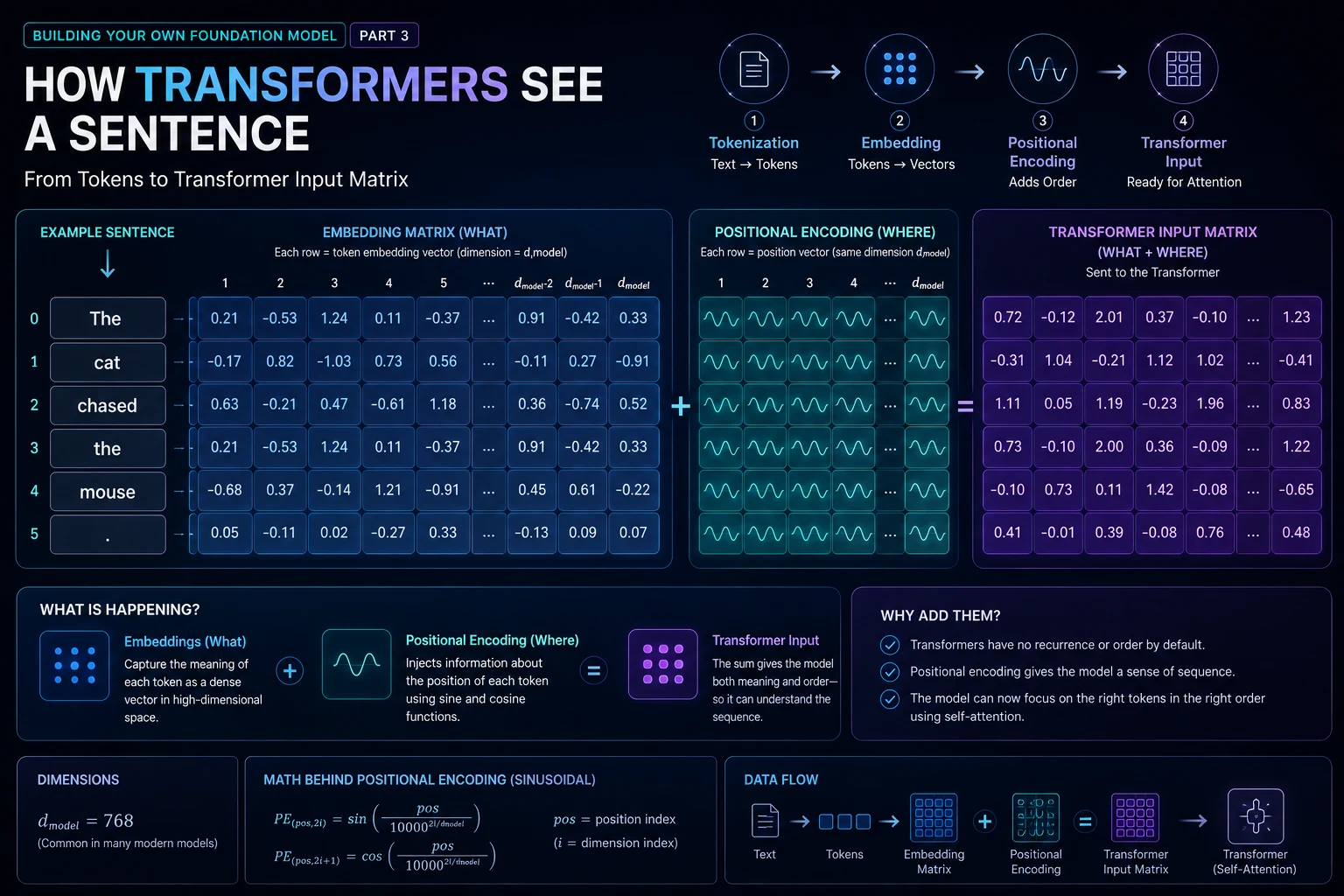
Every embedding receives another vector.
Embedding
+
Position
=
Transformer Input
Playground #2 — Position Slider ⭐
Move cat across positions. Embedding stays fixed; position vector changes; final vector updates.
Bonus — reorder a sentence
Click a word to move it to the front. Watch the flags: Embedding unchanged · Position changed.
Continue Reading
Explain why simply numbering words (1, 2, 3…) is not enough for deep models — we need a richer encoding (sin/cos or RoPE) that attention can use smoothly.
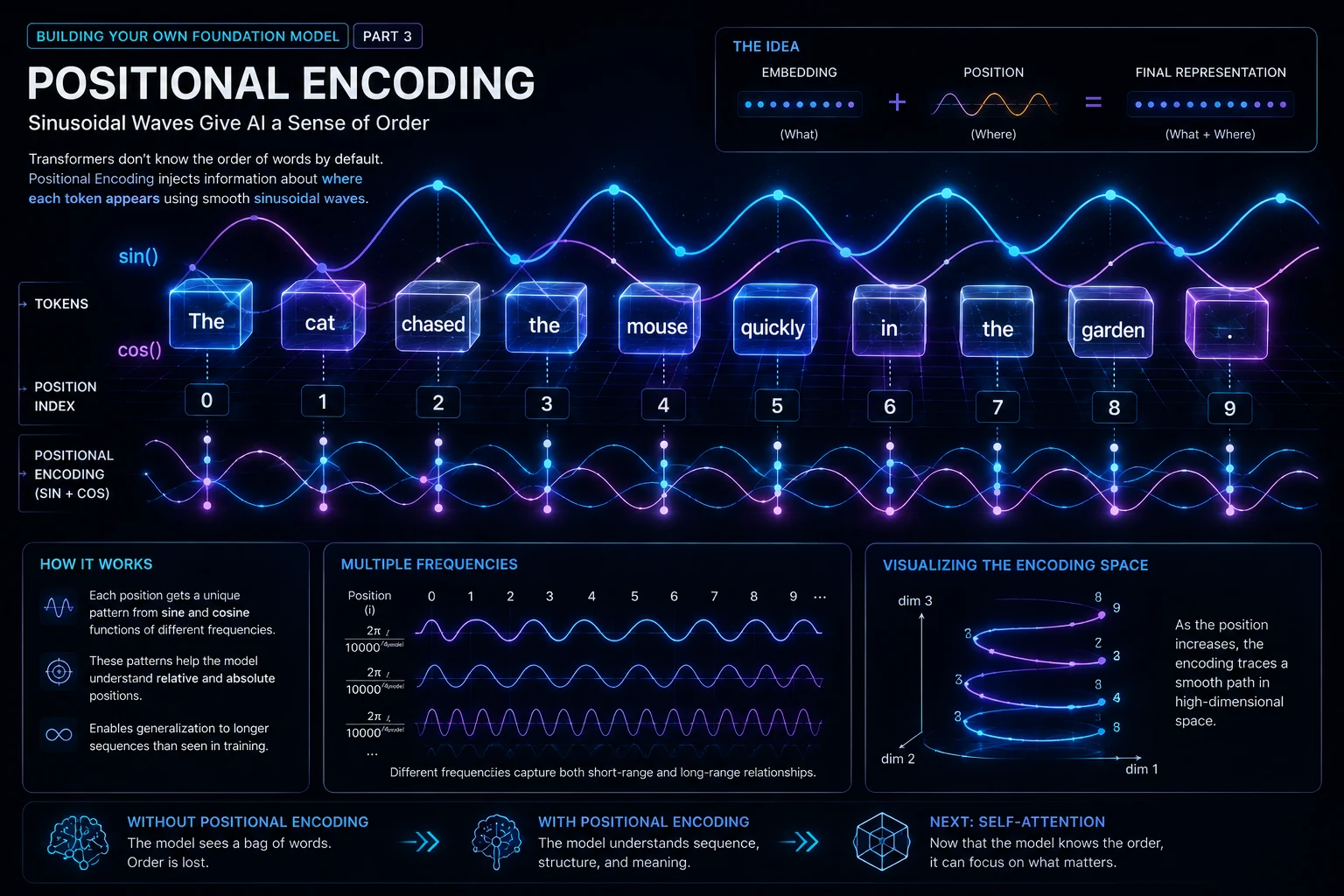
Explain Sinusoidal Encoding
Don't show equations first.
Explain visually.
Only then mathematics.
Playground #3 — Sin / Cos / RoPE Explorer ⭐
Switch Sin, Cos, and RoPE. Classic transformers add waves; modern LLMs rotate.
Continue Reading
Now introduce RoPE (Rotary Position Embedding) — the idea behind Llama and many modern LLMs.
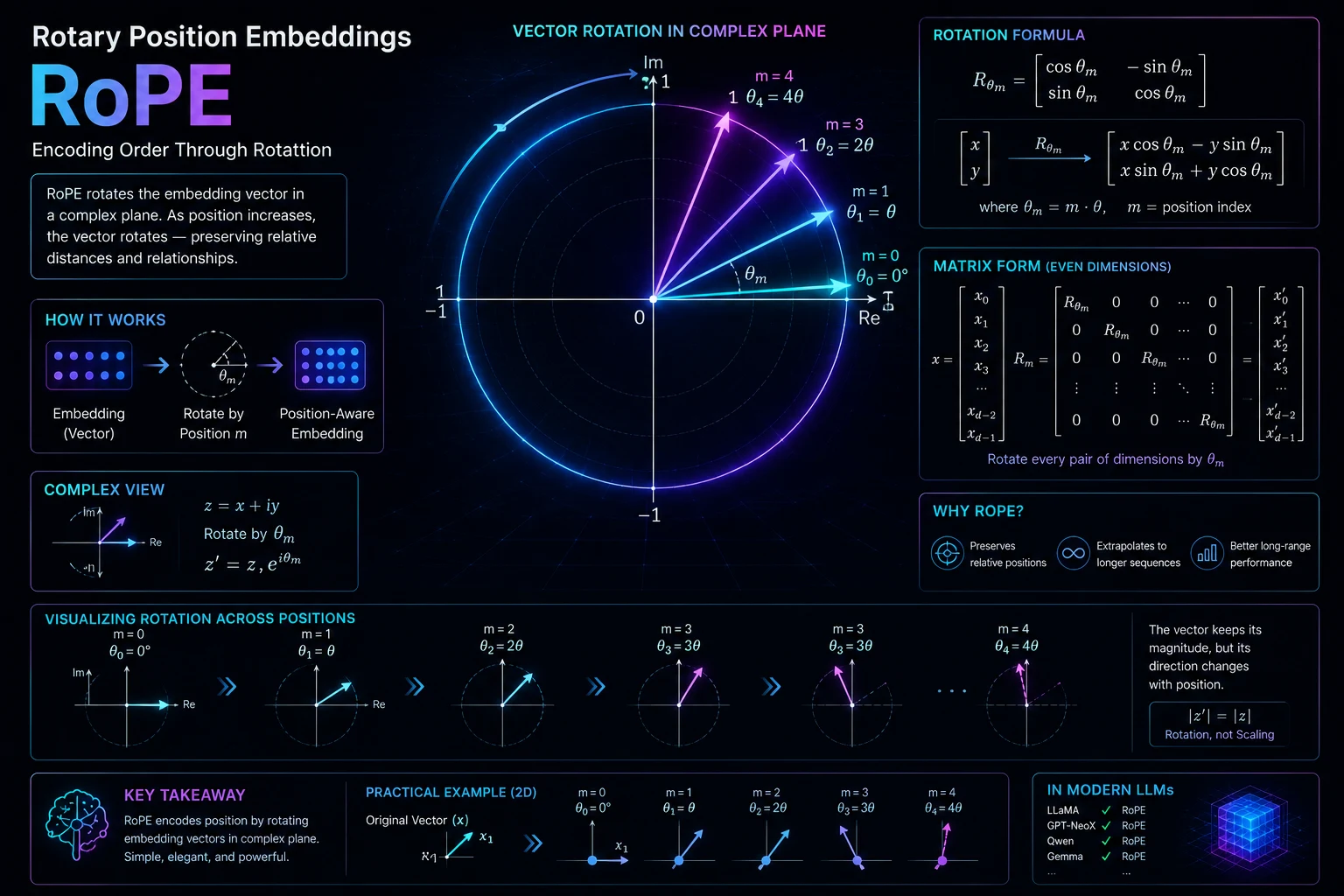
Playground #4 — RoPE Explorer ⭐
Drag position. The embedding vector rotates. That is why it is called Rotary.
See positions as a heatmap
Hover a token to inspect a demo slice of its position vector.
Continue Reading
Explain RoPE vs Sinusoidal in plain language, then show the model table.
Playground #5 — Sentence → Transformer Input
Each row = one token. Columns show Embedding · Position · Final input. Click a row to explain.
Playground #5b — Live code sketch
Left: sentence. Right: Python-style emb + pos updating live.
Continue Reading
Explain the Transformer Input Matrix idea: what actually enters the first attention layer.
Continue Reading
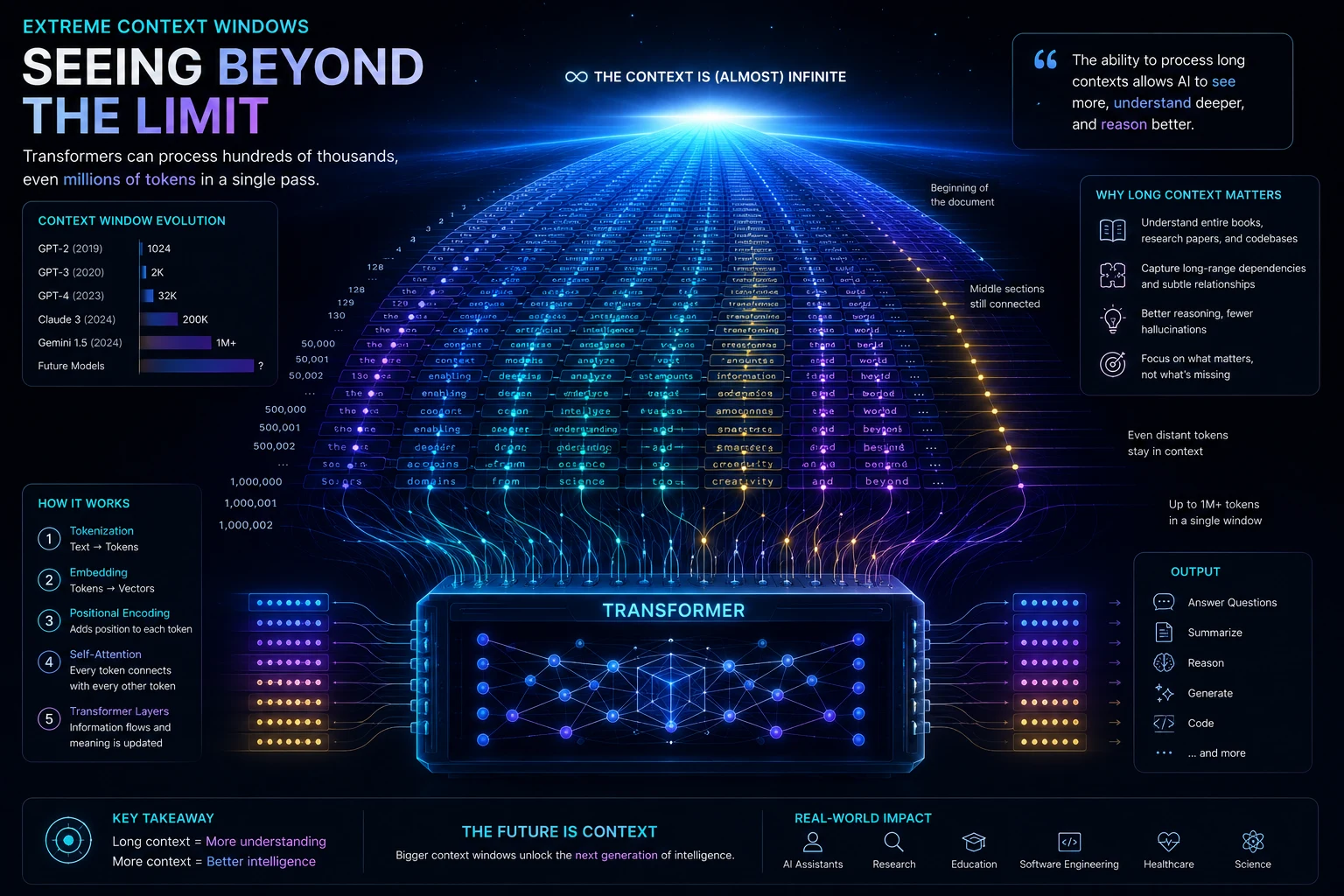
Explain Long Context — why 128k windows need encodings that still preserve relative relationships.
Playground #7 — Context Length Simulator ⭐
Slide from short sentences to 128k. Position span grows; RoPE still preserves relationships.
Challenge Section
🧠 Become the Transformer
You are the model. Without positions, the bag of words is ambiguous. Enable PE — then answer correctly.
Optional extra puzzle
Same lesson in puzzle form — skip this if you are near the 16-widget limit.
Research Corner
Include links and discussion of foundational work such as:
- Attention Is All You Need (original Transformer paper)
- RoFormer (introduces Rotary Position Embeddings)
- LLaMA architecture overview (use of RoPE)
- Long-context research (for modern context extension techniques)
Summarize each paper in 3–5 sentences and explain why it mattered instead of simply listing links.
Before today, you probably believed that embeddings were enough.
They're not.
Without positional encoding, Claude couldn't tell whether the cat chased the mouse or the mouse chased the cat.
And here's the fascinating part...
We've still not reached the most revolutionary idea inside a Transformer.
Next Episode Teaser
Part 4
Self-Attention: The Algorithm That Changed Artificial Intelligence Forever
You'll build Self-Attention from scratch, visualize attention heatmaps in real time, understand Query, Key, and Value vectors, and finally see how a Transformer decides which words deserve its focus.
Click cat — related tokens light up. Pulls readers into Part 4.
Series Progress
- ✅ Part 1 — What Really Happens When You Ask Claude?
- ✅ Part 2 — Why AI Sees Everything as Numbers
- ✅ Part 3 — Positional Encoding
- ⏳ Part 4 — Self-Attention Explained
- ⏳ Part 5 — The Mathematics Behind Attention
- ⏳ Part 6 — Building Your First Tokenizer
- ⏳ Part 7 — Building Your First Transformer