Astrophysicist Uses Codex for Black Hole Simulation
AI-assisted, human-edited
This article was drafted with the help of large language models and reviewed by a Shine Soft Corp engineer before publication. Facts, citations, and code samples were verified against the linked sources. All opinions and editorial direction belong to the editor.
Codex helps astrophysicist Chi-kwan Chan refine algorithms for simulating black holes, enabling more realistic modeling of extreme physics
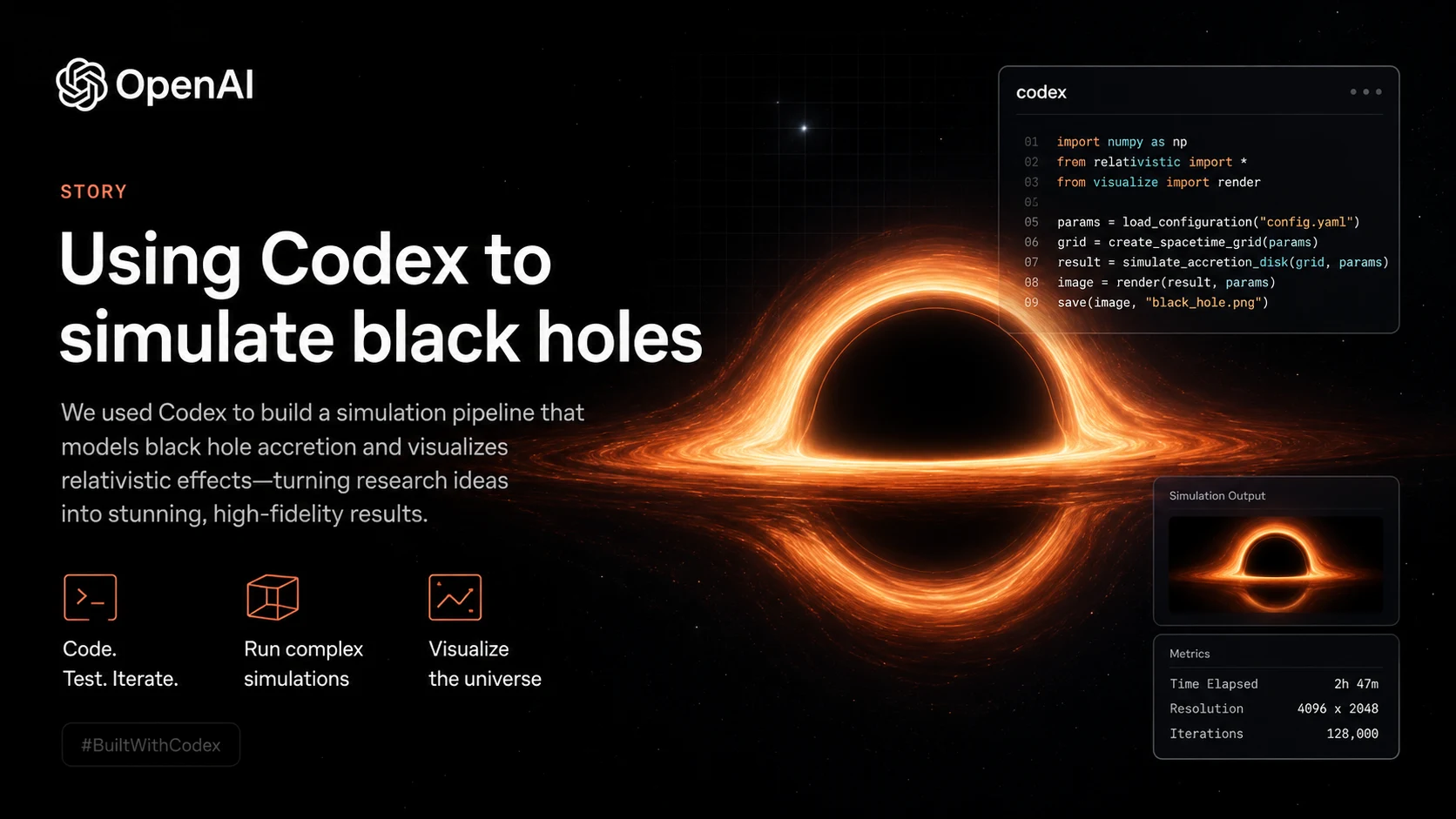
OpenAI's Codex Is Simulating Black Holes — And Scientists Are Paying Attention
How AI is helping physicists explore one of the universe's greatest mysteries.
The Universe Just Got a New Research Assistant
For decades, understanding black holes required some of the world's most powerful supercomputers and months of mathematical calculations.
Now, OpenAI researchers are showing that AI can do something few expected:
Help simulate black holes.
Using Codex, OpenAI's software engineering agent, scientists demonstrated how AI can accelerate complex physics simulations, potentially changing how researchers study some of the most extreme objects in the universe.
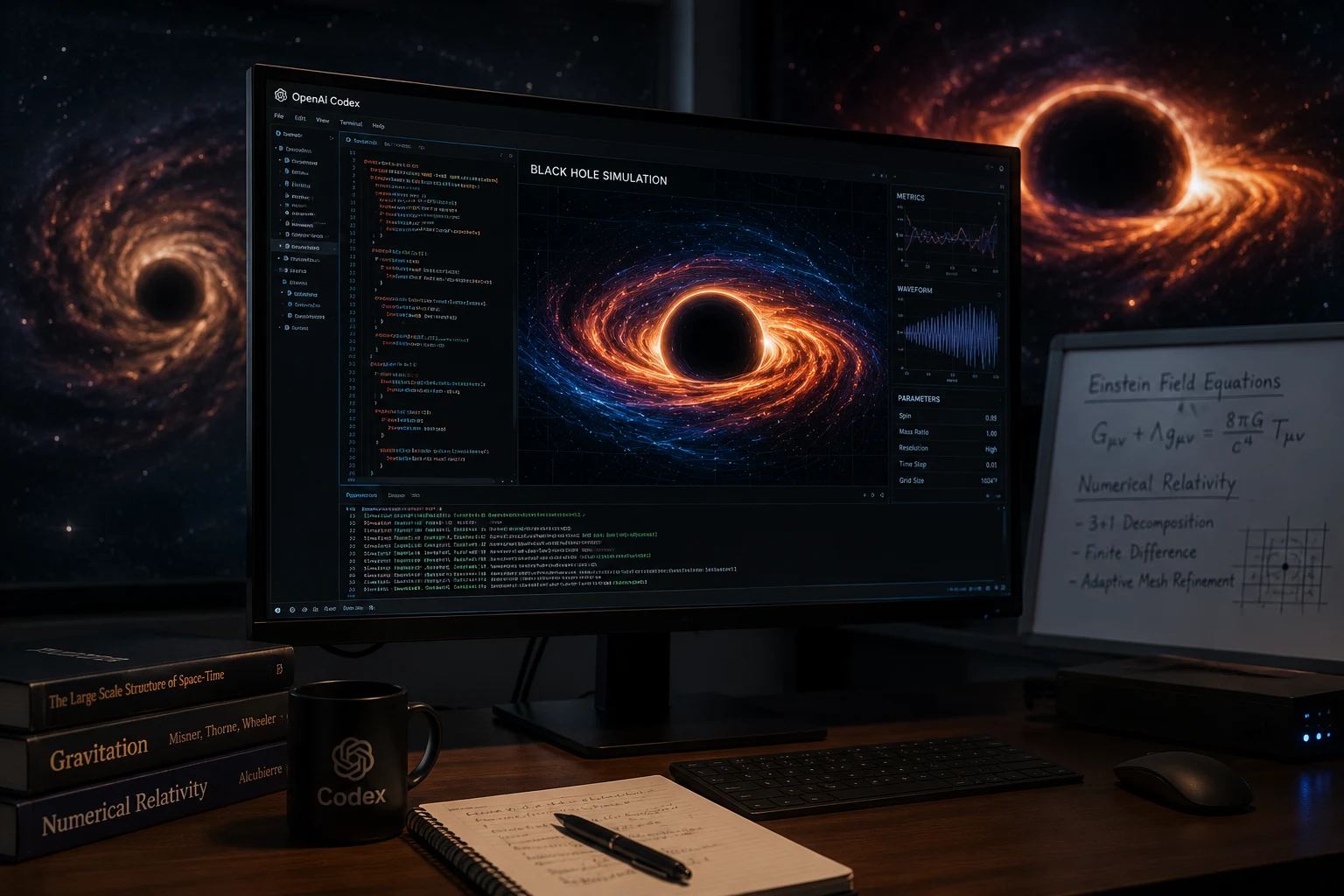
Why Black Holes Are So Difficult to Study
Black holes are among the most mysterious structures in the cosmos.
They:
- Bend space and time.
- Generate enormous gravitational forces.
- Produce complex mathematical equations.
- Require massive computational resources.
Even modern supercomputers can spend weeks solving the equations needed to model black hole mergers and gravitational waves.
Physicists often write thousands of lines of code to perform these simulations.
Enter Codex
Instead of manually writing every equation and optimization routine, researchers used Codex to assist with:
- Generating simulation code.
- Debugging numerical algorithms.
- Optimizing performance.
- Running experiments faster.
- Exploring different physical scenarios.
Rather than replacing scientists, Codex acted as an intelligent collaborator.
The Surprising Result
Researchers discovered that AI wasn't just producing code.
It was helping them:
- Iterate faster.
- Test more hypotheses.
- Discover implementation errors.
- Spend less time debugging.
- Focus on physics instead of boilerplate programming.
In effect, Codex became a force multiplier for scientific discovery.
Simulating Black Holes Is Incredibly Expensive
Traditional simulations require:
| Resource | Requirement |
|---|---|
| CPU Cores | Hundreds to Thousands |
| Memory | Hundreds of GB |
| Runtime | Days to Weeks |
| Programming Effort | Months |
| Expertise | Specialized Physicists |
AI reduces much of the software engineering overhead, allowing researchers to focus on the science itself.
Why This Matters Beyond Astrophysics
The implications extend far beyond black holes.
The same approach could accelerate research in:
Climate Modeling
Predicting long-term weather patterns.
Fusion Energy
Simulating plasma and reactor designs.
Particle Physics
Studying subatomic interactions.
Material Science
Discovering new superconductors and compounds.
Quantum Computing
Optimizing algorithms and architectures.
AI as a Scientific Co-Pilot
For years, AI was viewed primarily as a chatbot.
But OpenAI's latest demonstration highlights a larger trend:
AI is evolving into a research partner.
Scientists are beginning to use AI systems to:
- Write code.
- Analyze data.
- Generate hypotheses.
- Design experiments.
- Speed up discovery.
This shift could dramatically reduce the time between ideas and breakthroughs.
A Glimpse Into the Future
Imagine a world where researchers can simply ask:
"Simulate two rotating black holes with different masses."
And an AI agent generates:
- Numerical solvers.
- Optimized code.
- Visualizations.
- Performance improvements.
What once required months of programming could eventually take hours.
The Bigger Picture
Throughout history, scientific progress has depended on better tools:
- Telescopes transformed astronomy.
- Microscopes transformed biology.
- Supercomputers transformed physics.
AI may become the next great instrument of science.
And if machines can help humans understand black holes—
perhaps they can help us understand the universe itself.
Key Takeaways
✅ Codex helped researchers accelerate black hole simulations.
✅ AI acted as a collaborator, not a replacement.
✅ Scientists spent less time debugging and more time doing physics.
✅ Similar methods could revolutionize climate science, fusion energy, and quantum computing.
✅ AI is increasingly becoming a tool for scientific discovery.
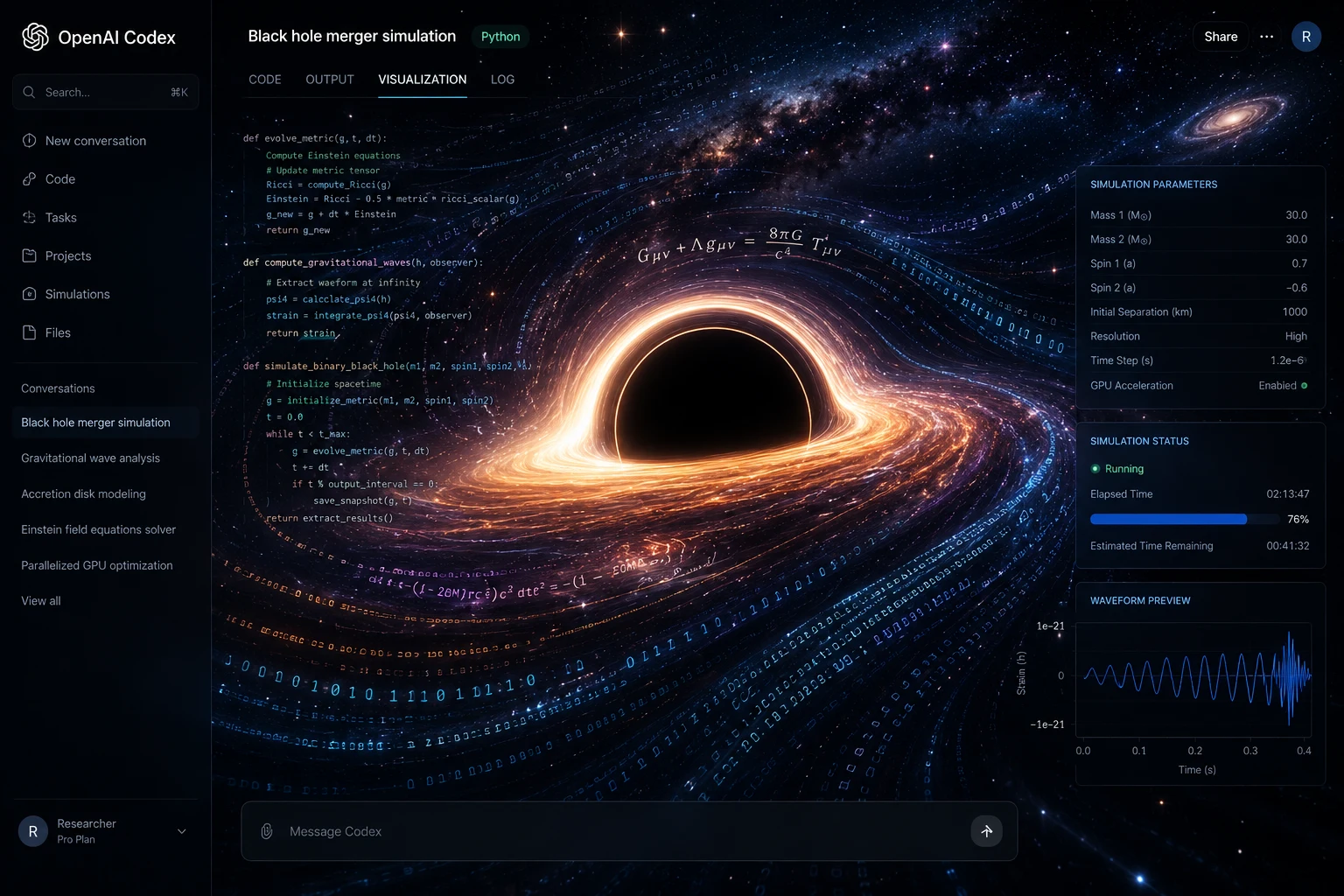
Section: "AI + Physics"
Side-by-side illustration:
| Traditional Research | AI-Assisted Research |
|---|---|
| Months of coding | Hours of iteration |
| Manual debugging | AI optimization |
| Limited experiments | Rapid exploration |
| Human only | Human + AI |
Timeline Graphic
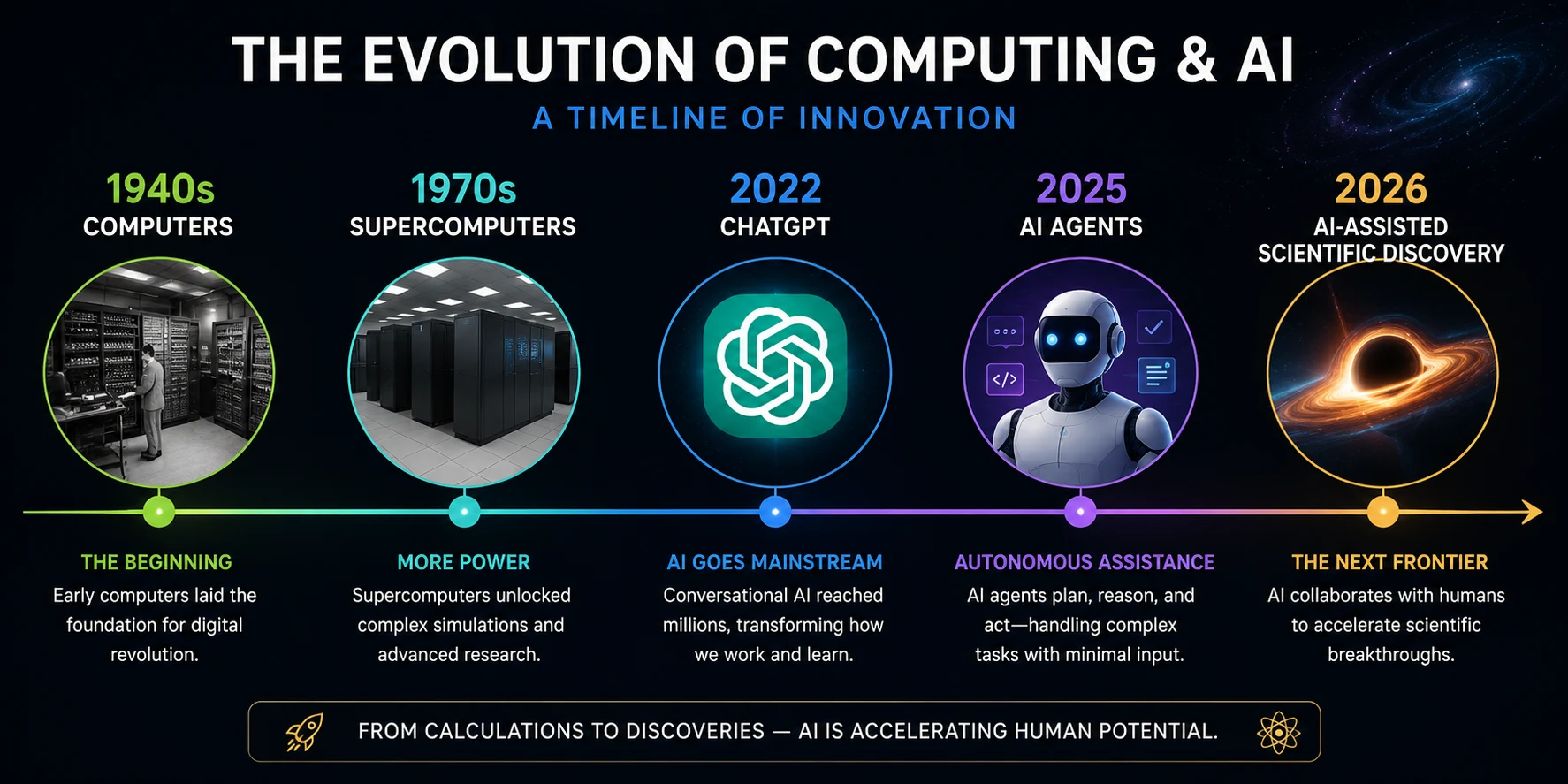
References
This article was informed by reporting and engineering write-ups from the sources below. Please visit them for the original analysis:
Shine Soft Corp synthesizes and commentates on these sources; we do not republish their content.