Anthropic Admits Claude Really Got Worse — And It Wasn't User Imagination
AI-assisted, human-edited
This article was drafted with the help of large language models and reviewed by a Shine Soft Corp engineer before publication. Facts, citations, and code samples were verified against the linked sources. All opinions and editorial direction belong to the editor.
Anthropic reveals three hidden bugs caused weeks of declining Claude performance, not a secret downgrade. Learn what happened and what AI companies can learn.
Anthropic Admits Claude Really Got Worse — And It Wasn't User ImaginationAnthropic reveals three hidden bugs caused weeks of declining Claude performance, not a secret downgrade. Learn what happened and what AI companies can learn.
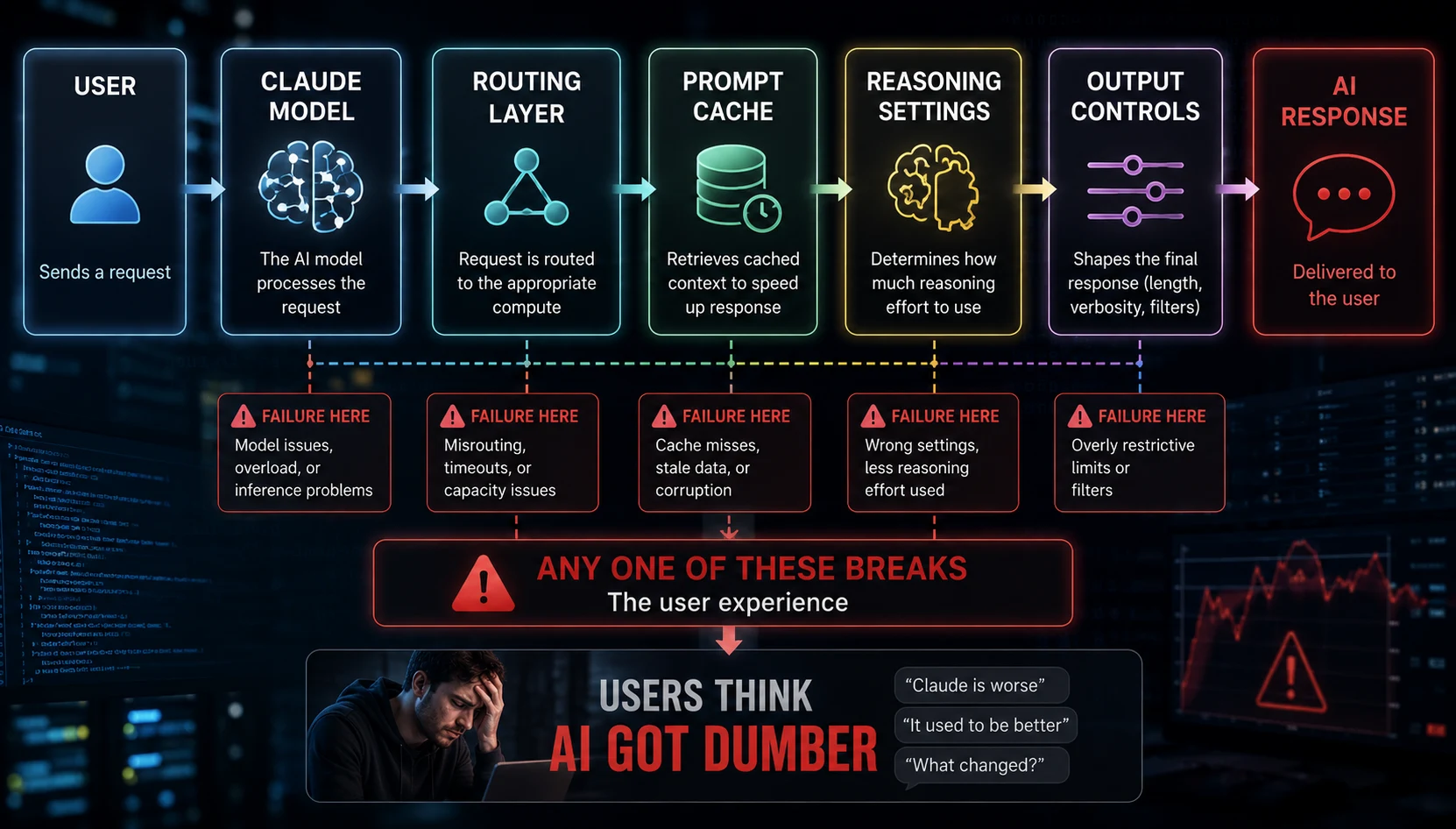
Users Thought Anthropic Secretly Nerfed Claude. The Truth Was Even Worse.
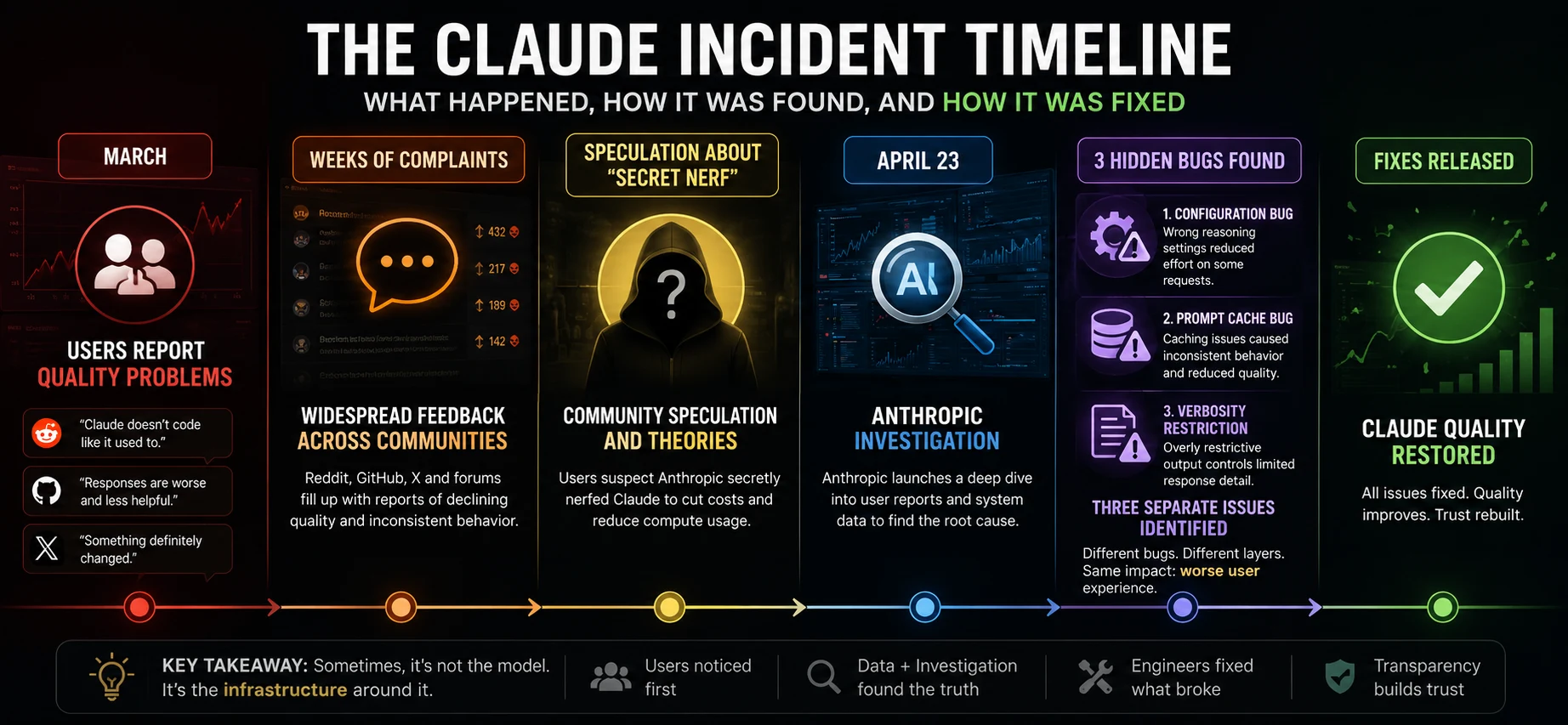
For weeks, developers across Reddit, GitHub, and X complained that Claude Code had become noticeably worse. Responses felt shorter, reasoning quality dropped, and many users accused Anthropic of intentionally "nerfing" the model to save compute costs.
According to Anthropic's engineering team, the users weren't imagining things.
And no, it wasn't a secret downgrade.
It was something arguably more concerning: multiple infrastructure bugs silently degrading the experience. (Business Insider)
What Actually Happened?
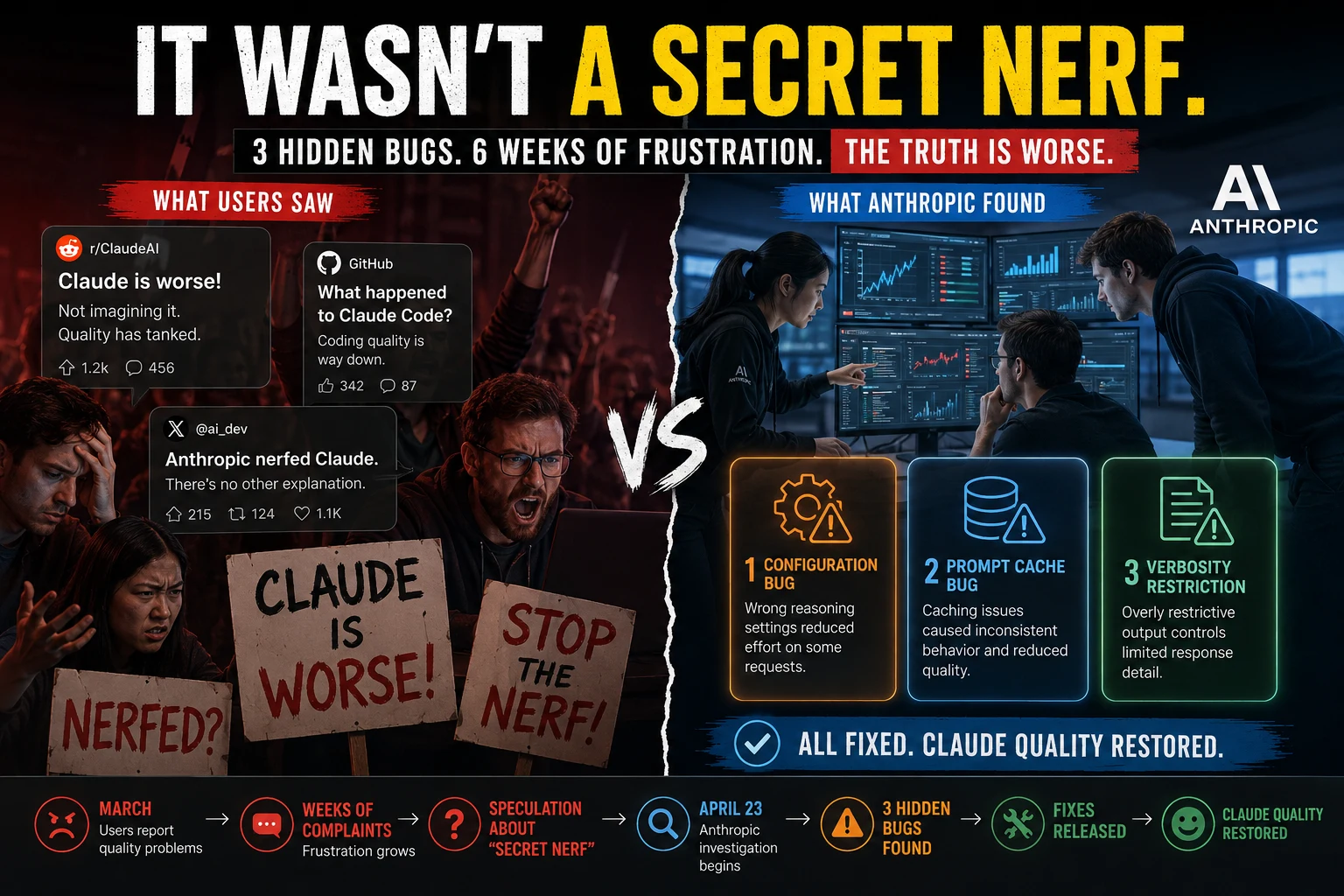
Anthropic investigated community reports and discovered that three independent problems had been affecting Claude Code simultaneously.
Because each issue impacted different requests and users, the symptoms appeared random and inconsistent.
Together, they created the impression that Claude had suddenly become less intelligent. (stackfutures.com)
Bug #1: The Wrong Reasoning Settings
One configuration change unintentionally reduced the amount of reasoning effort Claude used for some requests.
Less internal reasoning meant:
- More superficial answers
- Lower coding accuracy
- Reduced problem-solving capability
Users interpreted this as the model becoming "dumber."
Bug #2: Prompt Caching Problems
A second issue involved prompt caching.
Caching is supposed to improve speed and reduce costs, but under certain circumstances the system wasn't behaving as intended.
The result:
- Reduced consistency
- Strange behavior between sessions
- Unpredictable quality
What made the problem difficult was that only certain traffic patterns triggered it. (stackfutures.com)
Bug #3: Overly Restrictive Output Controls
Another change unintentionally limited Claude's verbosity.
Instead of detailed explanations, users received shorter and less helpful responses.
Many developers interpreted this as Anthropic deliberately cutting quality to reduce inference expenses.
According to the company, that wasn't the case.
The restrictions were eventually reversed. (Zen van Riel)
Why Users Suspected a Secret Downgrade
From the outside, the symptoms looked suspicious:
- Coding quality appeared worse.
- Answers became shorter.
- Token usage changed.
- Performance varied between users.
Naturally, many developers concluded that Anthropic had quietly reduced model capability to save money.
Anthropic explicitly denied this theory and published a rare public postmortem explaining the root causes. (Business Insider)
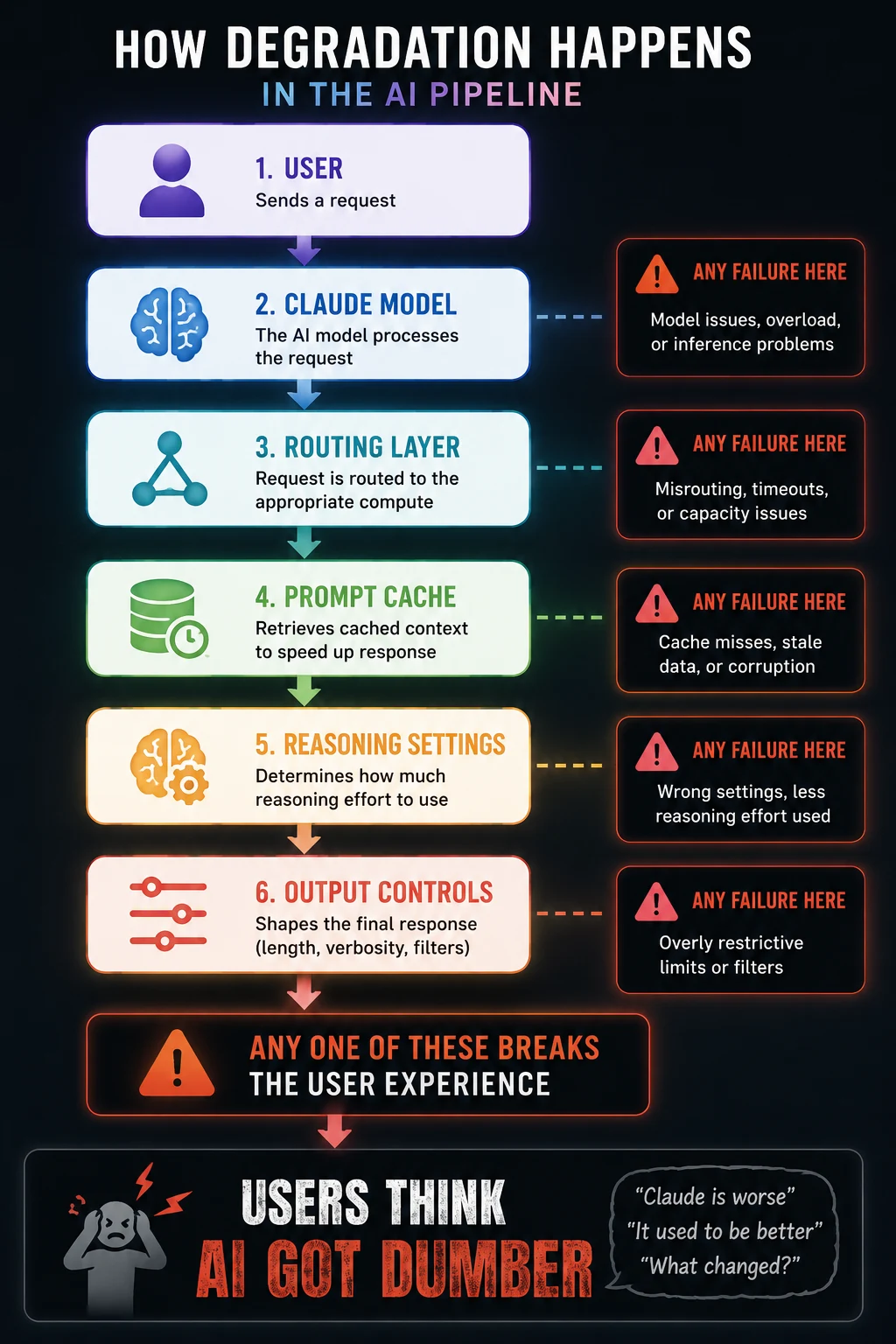
The Bigger Lesson: AI Models Are Becoming Infrastructure Problems
This incident highlights an uncomfortable reality.
Modern AI systems are no longer just about bigger models.
They're increasingly dependent on:
- Routing layers
- Prompt caches
- Compiler optimizations
- Hardware accelerators
- Configuration management
- Inference pipelines
Sometimes the model itself is perfectly fine.
Everything around it isn't.
As one industry observer noted:
Elite AI engineering often looks like exceptional software engineering wrapped around a smart model. (LinkedIn)
Transparency Matters
What stands out most is that Anthropic publicly documented the failures instead of dismissing user complaints.
Many companies would simply blame "normal variation."
Instead, Anthropic acknowledged the problems, explained their causes, and shipped fixes.
All three issues were eventually resolved. (Zen van Riel)
Final Thoughts
The Claude incident shows something every AI company should remember:
Users notice quality degradation long before dashboards do.
And in the age of AI, sometimes three tiny bugs are enough to convince millions of people that the model itself has become less intelligent.
Perhaps the scariest part wasn't that Claude got worse.
It was how difficult it was to tell whether the problem was the AI—or the infrastructure surrounding it.
Timeline Graphic
Architecture Diagram
This topic has strong potential for Hacker News, LinkedIn, X, and Facebook because it touches on one of the biggest fears in AI today:
"Are AI companies secretly making models worse?"
which naturally drives curiosity and discussion.
Was Claude's decline due to
Live results
What was the main issue with
Live results
How did Anthropic handle
Live results