AMD Starts Selling AI Computer That Runs Massive Models Locally — Could It End Expensive Cloud GPUs?
AI-assisted, human-edited
This article was drafted with the help of large language models and reviewed by a Shine Soft Corp engineer before publication. Facts, citations, and code samples were verified against the linked sources. All opinions and editorial direction belong to the editor.
AMD's new "AI lunchbox" is here. Powered by the Ryzen AI Max+ 395 and 128GB unified memory, this compact desktop can run giant AI models locally, potentially reducing cloud costs and challenging Nvidia's dominance in AI hardware.
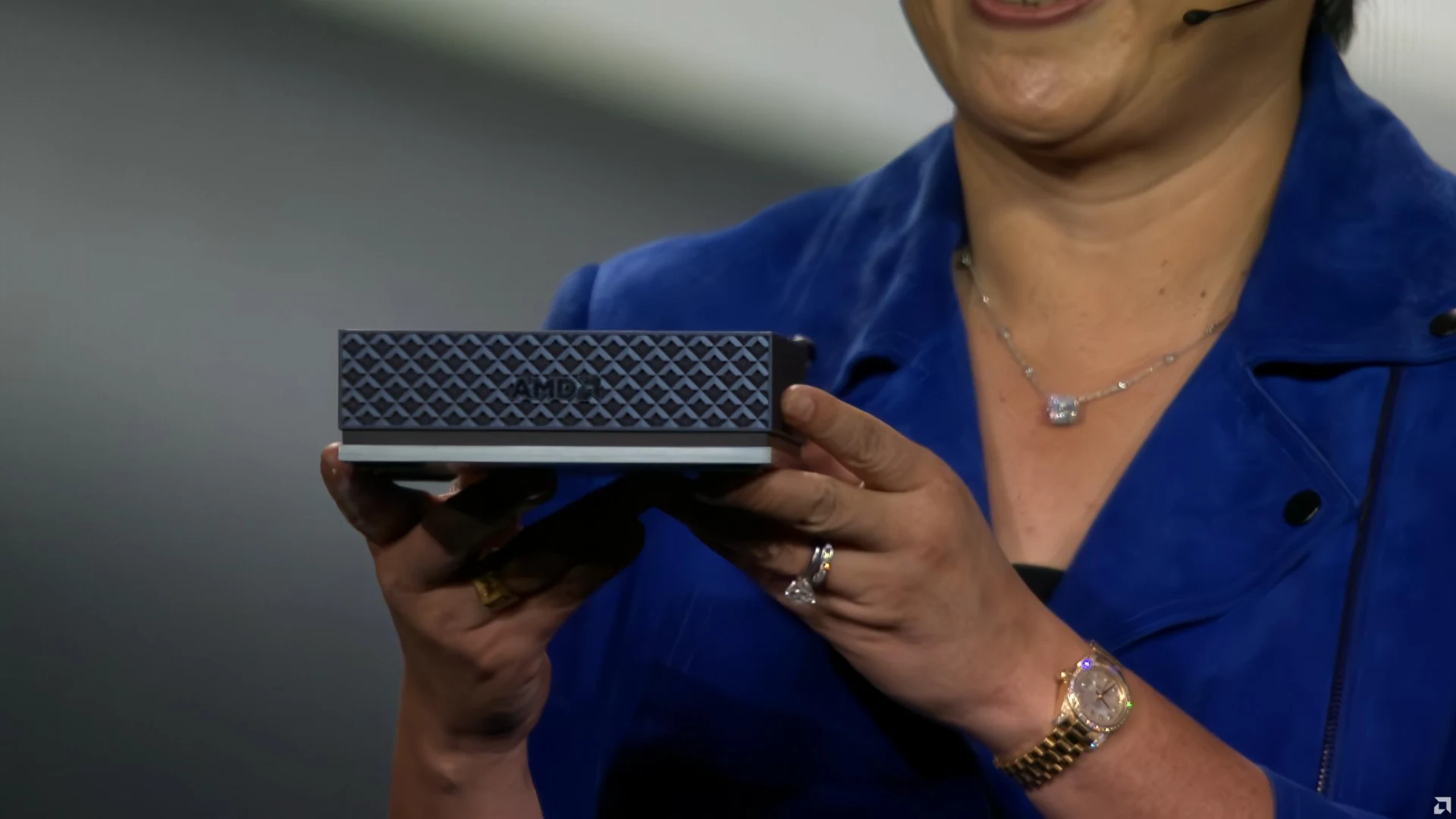
AMD Just Started Selling a Tiny AI Computer That Could Change Everything
Lisa Su's latest machine brings giant AI models to the desktop — no cloud required.
Published: June 15, 2026
The AI Industry May Be Entering a New Era

For years, running advanced AI models meant:
- Renting expensive cloud GPUs
- Building server racks
- Paying thousands every month
- Depending on Nvidia hardware
AMD thinks that future is changing.
Led by CEO Lisa Su, AMD has officially begun selling its new Ryzen AI Halo Developer Platform, a compact AI workstation designed to run massive language models locally. ([Tom's Hardware][1])
And the specifications are surprising.
A "Lunchbox" Sized Supercomputer
The machine is built around AMD's Ryzen AI Max+ 395 (Strix Halo) processor.
Despite fitting inside a tiny aluminum chassis, it contains:
| Specification | Details |
|---|---|
| CPU | 16 Zen 5 cores |
| Threads | 32 |
| Boost Clock | Up to 5.1 GHz |
| GPU | Radeon 8060S |
| Compute Units | 40 |
| AI Engine | XDNA 2 NPU |
| AI Performance | 50 TOPS |
| Memory | 128GB LPDDR5X |
| Storage | 2TB SSD |
| OS Support | Windows 11 Pro + Linux |
| Networking | Wi-Fi 7 + 10Gb Ethernet |
([Tom's Hardware][1])
The Secret Sauce: Unified Memory
The breakthrough isn't raw processing power.
It's memory.
Traditional systems separate:
- System RAM
- GPU VRAM
But AMD combines them into a single shared pool.
This allows AI workloads to access nearly the entire 128GB memory space.
Linux can reportedly dedicate around 110GB to GPU workloads, dramatically exceeding consumer graphics cards.
| Device | Memory Available for AI |
|---|---|
| RTX 4090 | 24 GB |
| RTX 5090 | 32 GB |
| DGX Spark | 128 GB Unified |
| AMD Ryzen AI Halo | 128 GB Unified |
Why This Matters

Large language models are usually limited by memory, not compute.
Many popular models need enormous VRAM:
| Model | Approximate Requirement |
|---|---|
| Llama 70B | 48–80 GB |
| Qwen3-235B | 100+ GB |
| GPT-OSS 120B | 90+ GB |
| Llama 4 Scout 109B | 90+ GB |
Until now, these models often required:
- Multiple RTX 4090s
- H100 servers
- Cloud subscriptions
AMD's new platform aims to make them accessible on a desktop.
AMD Is Going Directly After Nvidia
AMD's new machine enters the same market as Nvidia's DGX Spark.
But there are important differences.
| Feature | AMD Ryzen AI Halo | Nvidia DGX Spark |
|---|---|---|
| Price | $3,999 | ~$4,699 |
| Windows Support | Yes | No |
| Linux Support | Yes | Yes |
| Unified Memory | 128 GB | 128 GB |
| Processor | Ryzen AI Max+ 395 | Grace Blackwell |
| Form Factor | Mini PC | Mini PC |
AMD undercuts Nvidia by roughly $700. ([Tom's Hardware][1])
Why AI Developers Are Excited


Running models locally means:
Privacy
Sensitive data never leaves your machine.
Lower Cost
No monthly cloud fees.
Faster Iteration
Developers can test and fine-tune models without waiting for remote servers.
Independence
No dependence on rented GPUs.
The Bigger Trend
The industry is moving from centralized AI toward edge AI.
Instead of huge datacenters handling every request, increasingly powerful devices are bringing intelligence directly to users.
AMD's roadmap continues to push this direction.
Recently revealed Ryzen AI Max 400 "Gorgon Halo" chips will support up to 192GB of unified memory, enough for models exceeding 300 billion parameters. ([Tom's Hardware][2])
Could This Bring Down AI Costs?
That's the biggest question.
Today:
- Companies spend millions on AI infrastructure.
- Developers rent GPUs by the hour.
- Startups face high inference costs.
If local AI hardware becomes common, many workloads may move away from the cloud.
That could reduce:
- Operating costs
- Latency
- Data privacy concerns
And potentially challenge Nvidia's dominance.
Why Lisa Su's Bet Is Different
For years, the AI race focused on:
More GPUs.
AMD is betting on something else:
More memory.
Because the next bottleneck isn't necessarily compute power.
It's fitting ever-larger models into memory.
And AMD believes that problem can be solved inside a machine small enough to sit on your desk.
Final Thoughts
The most remarkable thing isn't that AMD made another processor.
It's that a device the size of a thick book can now perform tasks that previously required:
- Server racks
- Expensive GPU clusters
- Thousands of dollars in cloud bills
If this approach succeeds, the future of AI may not live entirely inside massive datacenters.
It might live right beside your monitor.
Section: "Unified Memory"
Create a comparison infographic:
RTX 4090 → 24GB
RTX 5090 → 32GB
AMD Ryzen AI Halo → 128GB
Future Gorgon Halo → 192GB
AMD Ryzen AI Halo vs Nvidia DGX Spark: Which AI Mini PC Offers Better Value?
Use side-by-side images: Yes. For the AMD vs Nvidia section, a side-by-side comparison table with images works very well for SEO and readability.
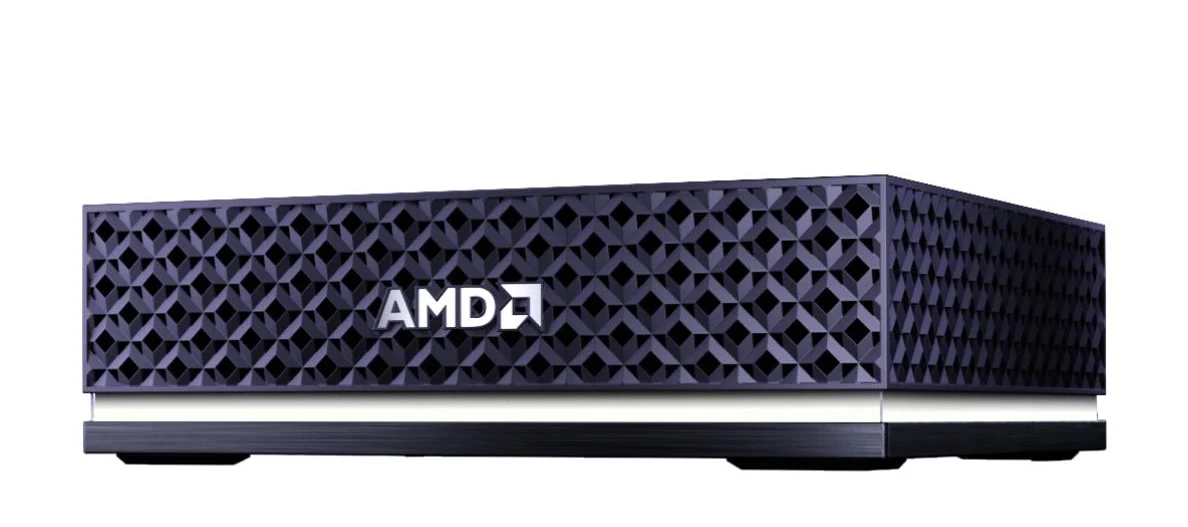
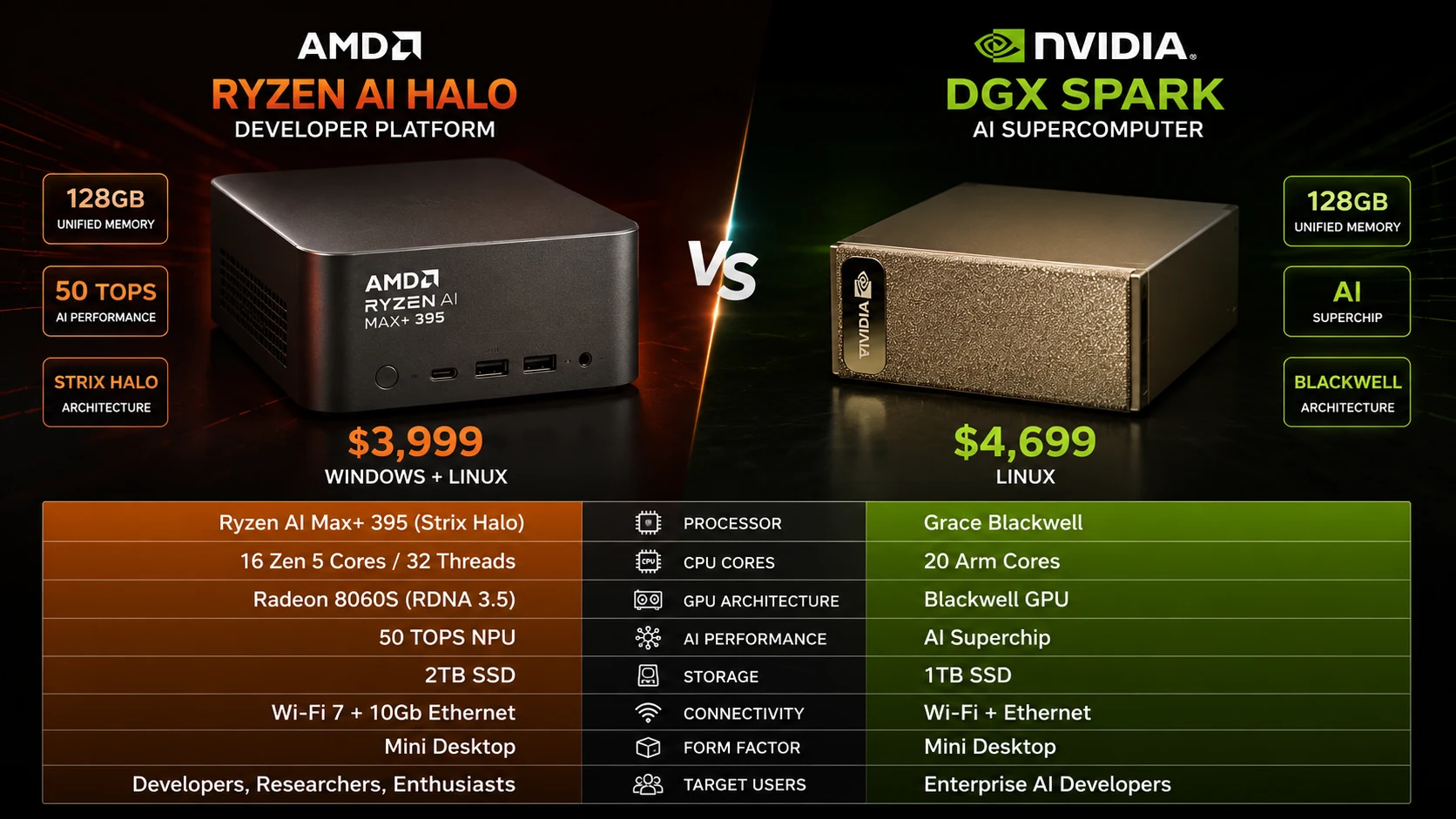
AMD Ryzen AI Halo vs Nvidia DGX Spark


| Feature | AMD Ryzen AI Halo Developer Platform | Nvidia DGX Spark |
|---|---|---|
| Price | $3,999 | ~$4,699 |
| Processor | Ryzen AI Max+ 395 (Strix Halo) | Grace Blackwell |
| CPU Cores | 16 Zen 5 Cores | 20 Arm Cores |
| AI Memory | 128GB Unified Memory | 128GB Unified Memory |
| GPU Architecture | Radeon 8060S (RDNA 3.5) | Blackwell GPU |
| AI Performance | 50 TOPS NPU | AI Superchip |
| Operating System | Windows 11 + Linux | Linux |
| Storage | 2TB SSD | 1TB SSD |
| Networking | Wi-Fi 7 + 10Gb Ethernet | Wi-Fi + Ethernet |
| Target Users | Developers, Researchers, AI Enthusiasts | Enterprise AI Developers |
| Cloud Required | No | No |
| Form Factor | Mini Desktop | Mini Desktop |
| Big Advantage | Lower price + Windows support | Nvidia CUDA ecosystem |
| Winner | 💰 Better Value | 🧠 Stronger AI Ecosystem |
Memory Comparison
| AMD | Nvidia |
|---|---|
 |
 |
| Hardware | Available AI Memory |
|---|---|
| RTX 4090 | 24 GB |
| RTX 5090 | 32 GB |
| RTX Pro 6000 Blackwell | 96 GB |
| AMD Ryzen AI Halo | 128 GB Unified Memory |
| Future AMD Gorgon Halo | 192 GB Unified Memory |
Size Comparison
| Device | Approximate Size |
|---|---|
| Server Rack | 🗄️ Entire Cabinet |
| Multi-GPU Workstation | 🖥️ Large Tower |
| Nvidia DGX Spark | 📚 Small Desktop |
| AMD Ryzen AI Halo | 📕 Thick Paperback Book |